These notes were written by the person who submitted this item. Appraiser.AI has not verified them, and the AI's identification and estimate may rely on them.
AI Estimated Value
Not an official valuation
$25 - $45
AI estimate as of September 18, 2025 · verify with a professional before acting
AI-Generated · Verify before acting
Everything on this page is generated by AI for informational purposes only. AI can make mistakes — the AI may misidentify items or misattribute them (artist, maker, brand, designer, origin, era). This is not an official valuation and should not be used for insurance, sale, tax, estate, legal, or lending purposes — or any decision requiring a certified appraisal. It is not an authoritative claim about any person, brand, or rights holder — do not share or rely on it as a factual statement about a third party. Always consult qualified professionals before making financial decisions.
This analysis also relies on unverified notes provided by the user, which may be incomplete or inaccurate and could affect the result.
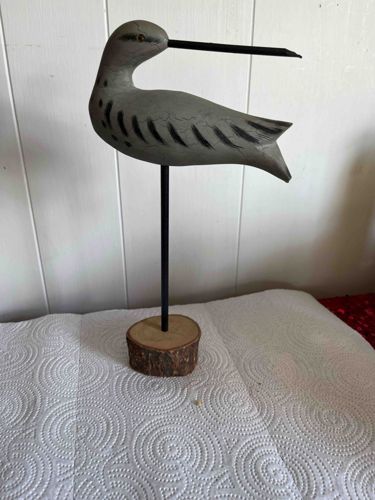
This item is a decorative carving depicting a shorebird, likely a curlew or similar species, presented as a stylized decoy. It is crafted from wood, as indicated by the context, and features a predominantly grey body with darker grey or black painted feather details simulated by short, curved strokes on its back and flank. The bird has a distinctively long, thin, and slightly downward-curved black beak which appears to be a separate piece securely inserted into the head, enhancing its realistic appearance. Small, bright yellow or amber-colored eyes are painted or inset, adding a touch of life to the bird's expression. The overall finish of the bird is matte, suggesting either unvarnished wood or a very subtle, low-sheen coating. The carving is mounted on a slender, black-painted metal rod or dowel, which in turn is affixed to a natural wood slice base. The base retains its bark edge, giving it a rustic appeal, and the top surface of the wood slice shows the natural grain. The 'Heritage Mint Ltd.' context suggests this is a mass-produced decorative item, likely dating from the mid-to-late 20th century or early 21st century, often sold in gift shops or home decor stores. The condition appears to be good, with no visible significant damage, chips, or cracks, and the paint seems largely intact. The craftsmanship is consistent with decorative carvings, with smooth lines and a balanced form. The natural wood base with the bark edge is a particularly unique aspect, contrasting with the more refined bird carving.
AI Appraisal Report
I have carefully examined the provided image and details of this Heritage Mint Ltd. carved wooden shorebird decoy. The item presents as a decorative carving, likely depicting a curlew, made of wood with painted details. Its condition appears good visually, with no obvious significant damage, chips, or cracks, and the paint seems largely intact. The distinctive long, curved beak and the bright amber eyes are notable features, along with the rustic natural wood slice base retaining its bark edge.
Authenticity, in terms of it being a Heritage Mint Ltd. product, is supported by the owner's statement. However, without a physical examination for any manufacturer's marks or labels, I cannot definitively confirm this from the image alone. The craftsmanship is consistent with decorative mass-produced items from brands like Heritage Mint Ltd., which typically date from the mid-to-late 20th century or early 21st century.
Market conditions for such decorative carvings are generally stable but do not command high prices. They are considered decorative collectibles rather than fine art or antique decoys. Comparables in the resale market (e.g., online marketplaces, вторичный shops) for similar Heritage Mint Ltd. decorative carvings suggest a modest value.
Demand for these items is niche, primarily from individuals seeking rustic or avian-themed home decor. They are not rare; Heritage Mint Ltd. produced a significant volume of such items. The primary factors impacting value are the very good condition and the appealing aesthetic of the natural wood base. Conversely, its mass-produced nature and lack of artistic provenance or age significantly limit its upper value.
For full authentication of its origin and to detect any subtle condition issues (e.g., minor scuffs, repairs, paint flaking not visible in the image), an in-person examination would be necessary. This would allow me to inspect for maker's marks, assess the wood type more accurately, and confirm the method of beak attachment and paint application. Without this, I rely heavily on visual cues and the owner's stated information.