AI Appraisal Estimate

AI-generated estimates · not official valuations

From the user

What was submitted

Photo and notes provided by the user — not generated by AI

Submitted item photo
Submitted photo · May 28, 2026

User's notes

Ivory Alaskan art

AI analysis below

AI appraisal

AI analysis & estimate

AI-Generated · Verify before acting

Everything below is generated by AI for informational purposes only. AI can make mistakes — the AI may misidentify items or misattribute them (artist, maker, brand, designer, origin, era). This is not an official valuation and should not be used for insurance, sale, tax, estate, legal, or lending purposes — or any decision requiring a certified appraisal. It is not an authoritative claim about any person, brand, or rights holder — do not share or rely on it as a factual statement about a third party. Always consult qualified professionals before making financial decisions.

Note

This analysis also relies on unverified notes provided by the user, which may be incomplete or inaccurate and could affect the result.

Read the full disclaimer

AI Identification

·Not independently authenticated·Verify before acting

Carved Eagle Figure

Sculpture/Carving

AI Estimated Value

·Not an official valuation·Verify before acting

$450 - $650

As of May 28, 2026

AI Item Analysis

·AI can make mistakes·Verify before acting
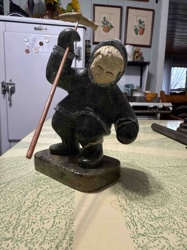
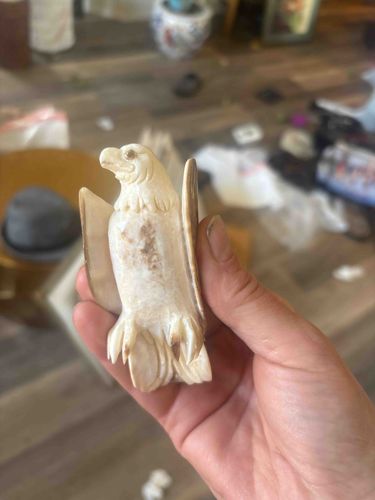
The item is a naturalistic carving of an eagle, likely crafted from walrus ivory or bone, given the context of "Ivory Alaskan art." It measures approximately 4-6 inches in height, fitting comfortably within an adult's hand as shown in the image. The material exhibits a creamy off-white to yellowish-brown coloration, with natural striations and areas of darker pigmentation, particularly noticeable on the body and lower sections, suggesting the inherent characteristics of the raw material or a natural patina over time. The carving depicts the eagle with its wings held close to its body, possibly in a perched or resting position. The head is detailed with a prominent beak and incised eyes, giving the bird a focused gaze. The feathers are rendered through a series of shallow, parallel incisions and sculpted layers, particularly around the neck and on the lower body, resembling the texture of plumage. The base or feet of the sculpture appear to integrate into the overall form rather than being sharply defined, with carved elements suggesting talons or tail feathers that provide a stable, flat base for display. The craftsmanship appears to be of good quality, with attention to detail in the bird's anatomy and feathering, indicative of skilled carving. There are no immediately obvious signs of major damage or repairs, though the natural discoloration might be mistaken for wear. The surface appears smooth in some areas and exhibits a soft sheen typical of polished bone or ivory. The style suggests an indigenous Alaskan or North American carving tradition, likely from the mid-20th century or earlier, aligning with historical production of such art pieces from natural materials.
AI Appraisal Report

·AI can make mistakes·Verify before acting
Upon examining the images of this carved eagle figure, purportedly of Alaskan origin, I assess it to be a skillfully executed piece. The carving displays a naturalistic representation of an eagle, with fine detailing in the feather texture and a strong, focused expression. The material, described as ivory, shows a creamy coloration with natural striations and a patina consistent with age, possibly walrus ivory or bone. Its condition appears good, with no obvious cracks, chips, or repairs visible from the photographs provided. The piece aligns stylistically with mid-20th century Alaskan Native work. The market for authentic Alaskan Native carvings remains steady, with significant value placed on signed pieces by known artists or those with clear provenance. This unsigned piece would be valued based on its artistic merit, material, and age. Comparable unsigned ivory or bone carvings of similar size and quality often sell in the $400 to $800 range at auction and in specialty galleries. The key factor affecting its value is the material's authenticity. While it appears to be genuine ivory or bone, I cannot definitively confirm this without a physical examination. For full authentication, an in-person inspection to assess weight, texture, and Schreger lines (if mammoth or elephant ivory) or a Hot Pin Test (if determined to be ethical) would be necessary for bone vs. ivory confirmation. Furthermore, without provenance or a signature, its specific origin remains attributed rather than confirmed, which limits its value potential compared to fully documented works.

Get your items appraised

Instant estimates of your treasures with AI-powered appraisals

Browse More Appraisals