These notes were written by the person who submitted this item. Appraiser.AI has not verified them, and the AI's identification and estimate may rely on them.
AI Estimated Value
Not an official valuation
$600 - $900
AI estimate as of November 28, 2025 · verify with a professional before acting
AI-Generated · Verify before acting
Everything on this page is generated by AI for informational purposes only. AI can make mistakes — the AI may misidentify items or misattribute them (artist, maker, brand, designer, origin, era). This is not an official valuation and should not be used for insurance, sale, tax, estate, legal, or lending purposes — or any decision requiring a certified appraisal. It is not an authoritative claim about any person, brand, or rights holder — do not share or rely on it as a factual statement about a third party. Always consult qualified professionals before making financial decisions.
This analysis also relies on unverified notes provided by the user, which may be incomplete or inaccurate and could affect the result.
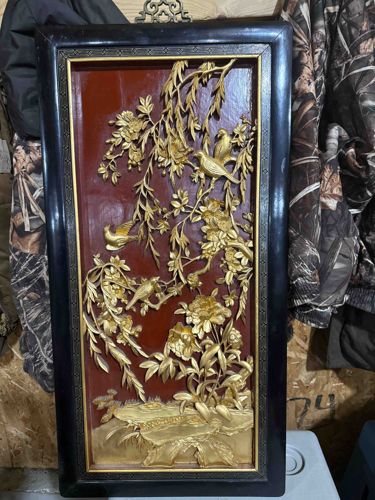
This item is a rectangular giltwood carved wall panel, featuring a highly ornate relief carving of birds amidst a vibrant botanical scene. The overall dimensions appear to be approximately 2-3 feet in height and 1-2 feet in width, framed by a substantial, glossy black wooden border. The central carved element, which is the focal point, is finished in a brilliant gold lacquer or gilt, creating a striking contrast against the rich, dark reddish-brown background of the panel itself. The carving depicts at least three birds, possibly swallows or finches, perched among flowering branches and foliage, with what appears to be peony or chrysanthemum-like blossoms. The branches extend from the top and middle sections, creating a sense of depth and movement. In the lower section, there is a depiction of land or rock formations, also intricately carved and gilded. The craftsmanship is evident in the finely detailed feathers of the birds, the delicate veins of the leaves, and the multi-layered petals of the flowers, suggesting skilled hand-carving. The frame has a slightly recessed inner golden trim, further accentuating the central artwork. While specific manufacturing marks are not visible in the image, the style points to an East Asian origin, likely Chinese, and could date from the late 19th to mid-20th century, a period known for such decorative carved panels. The 'excellent condition' context suggests minimal wear, no visible cracks, chips, or significant loss of gilding, and the black frame appears to be well-preserved with a consistent shine. The detailed relief work and contrasting colors contribute to its decorative appeal and would indicate a piece of good quality and artistic merit.
AI Appraisal Report
Upon visual examination of the provided imagery, this Giltwood Carved Wall Panel presents as a fine example of East Asian decorative art, most likely of Chinese origin, dating from the late 19th to mid-20th century. The piece features high-relief carving of birds amongst botanicals, a popular and auspicious theme. The craftsmanship appears to be of high quality, with notable detail in the feathers, leaves, and floral petals. The 'excellent condition' reported by the owner seems consistent with the visual evidence, which shows vibrant, largely intact gilding and a well-preserved lacquered frame.
The market for such decorative panels is steady, driven by interior design trends favoring Chinoiserie and ornate detailing. Comparable pieces from this era, in similar condition and quality, typically sell at auction or in retail settings within the $600 to $900 range. The value is significantly influenced by the skilled hand-carving and strong decorative appeal. The contrast between the brilliant gilt and the dark red-brown and black lacquered background makes it visually striking.
It is important to note the limitations of an appraisal based on photographs alone. While the style and technique are consistent with the period, a definitive authentication cannot be made without physical inspection. An in-person examination would allow for closer inspection of the wood, tool marks, joinery techniques, and the composition of the gilt and lacquer to confirm age and origin. Verifying authenticity would be further enhanced by any available provenance documentation or, in some cases, material analysis to date the wood and finishes.