AI Appraisal Estimate

AI-generated estimates · not official valuations

From the user

What was submitted

Photo and notes provided by the user — not generated by AI

Submitted item photo
Submitted photo · June 25, 2026

User's notes

No additional notes provided.

AI analysis below

AI appraisal

AI analysis & estimate

AI-Generated · Verify before acting

Everything below is generated by AI for informational purposes only. AI can make mistakes — the AI may misidentify items or misattribute them (artist, maker, brand, designer, origin, era). This is not an official valuation and should not be used for insurance, sale, tax, estate, legal, or lending purposes — or any decision requiring a certified appraisal. It is not an authoritative claim about any person, brand, or rights holder — do not share or rely on it as a factual statement about a third party. Always consult qualified professionals before making financial decisions.

Read the full disclaimer

AI Identification

·Not independently authenticated·Verify before acting

Hand-Carved Hopi Owl Katsina (Kachina) Doll

Native American Art & Collectibles

AI Estimated Value

·Not an official valuation·Verify before acting

$400 - $650

As of June 25, 2026

AI Item Analysis

·AI can make mistakes·Verify before acting
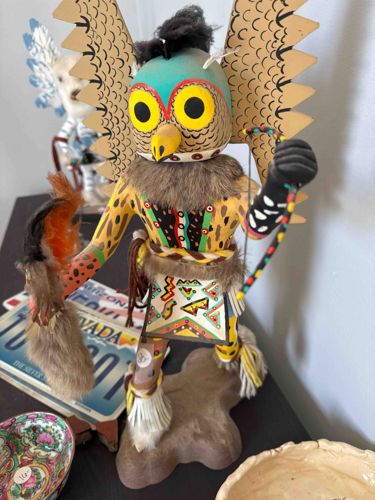
This is a contemporary, hand-carved and hand-painted Southwest Indigenous art piece, specifically a Hopi Owl (Mongwa) Katsina doll. The figure is constructed primarily of light wood, likely traditional cottonwood root, standing approximately 10 to 12 inches tall on a naturalistic brown base. The figure features a vibrant turquoise and tan owl head with prominent yellow owl-eyes and a protruding yellow beak. Large scalloped wings are attached to the back, painted in a tan hue with black feather detailing. It is adorned with various multimedia elements including real rabbit fur around the neck and waist, a black wool tuft on the head, and leather fringing on the boots. The figure holds a traditional bow in its left hand and a feathered wand or rattle in its right. The body is intricately painted with yellow leopard-style spots, a multi-colored geometric apron (kilt), and white-fringed boots. The condition appears excellent with no visible breaks or repairs; paint saturation remains high and the fur is intact. The detail in the painting and the complexity of the added materials suggest it was made by a skilled artisan in the late 20th to early 21st century. High-quality craftsmanship is evident in the dynamic pose and the precise application of both paint and natural fibers.
AI Appraisal Report

·AI can make mistakes·Verify before acting
Based on my visual examination of the images provided, this appears to be a well-executed, contemporary Hopi 'Mongwa' (Great Horned Owl) Katsina doll, likely dating to the late 20th or early 21st century. The piece exhibits the hallmarks of traditional craftsmanship, utilizing what appears to be hand-carved cottonwood root. The dynamic posture, rather than the stiffer, columnar form of older dolls, points to 'action style' carving popular from the 1970s onward. The mixed media elements—including the rabbit fur ruff, leather fringe, and distinct feather detailing on the wings—are intact and vibrant, indicating excellent condition with high paint saturation. The market for contemporary Katsinam is steady, though highly dependent on the identity of the artist. Without a visible signature or hallmark on the base, which is standard for collectibles of this caliber, the valuation is constrained to the level of a high-quality 'decorative' or skilled artisan piece rather than a masterpiece by a renowned carver like Neil David Sr. or Stetson Honyumptewa. Comparable unsigned or lesser-known artist works of this complexity generally sell in the mid-hundreds. Authenticity limitation is a primary factor here. While the materials look correct for authentic Hopi manufacture, there is a prominent market for non-Native imitations. An in-person inspection is crucial to verify the weight (lightness suggests cottonwood) and grain of the wood, and to check the base for any faint signatures. Provenance documentation establishing the original purchase from a reputable gallery or the artist directly would significantly bolster the value toward the higher end of the estimate.

Get your items appraised

Instant estimates of your treasures with AI-powered appraisals

Browse More Appraisals