AI Appraisal Estimate

AI-generated estimates · not official valuations

From the user

What was submitted

Photo and notes provided by the user — not generated by AI

Submitted item photo
Submitted photo · June 4, 2026

User's notes

No additional notes provided.

AI analysis below

AI appraisal

AI analysis & estimate

AI-Generated · Verify before acting

Everything below is generated by AI for informational purposes only. AI can make mistakes — the AI may misidentify items or misattribute them (artist, maker, brand, designer, origin, era). This is not an official valuation and should not be used for insurance, sale, tax, estate, legal, or lending purposes — or any decision requiring a certified appraisal. It is not an authoritative claim about any person, brand, or rights holder — do not share or rely on it as a factual statement about a third party. Always consult qualified professionals before making financial decisions.

Read the full disclaimer

AI Identification

·Not independently authenticated·Verify before acting

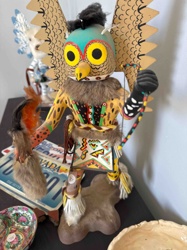
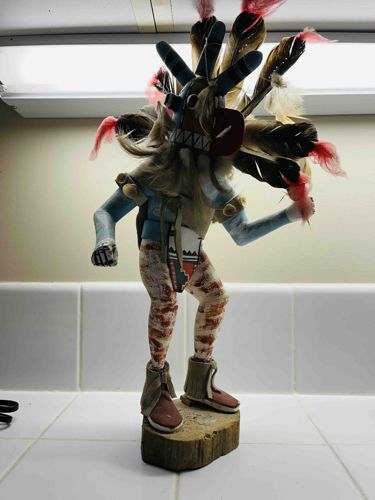
Hopi-style Crow Mother (Angwusnasomtaka) Kachina Doll

Native American Art & Collectibles

AI Estimated Value

·Not an official valuation·Verify before acting

$450 - $700

As of June 4, 2026

AI Item Analysis

·AI can make mistakes·Verify before acting
This is a hand-carved and mixed-media Kachina (Katsina) doll, likely representing the Crow Mother (Angwusnasomtaka). The figure stands on a circular wooden cross-section base and exhibits a dynamic, action-oriented pose. The body is constructed from carved wood, featuring light blue painted arms and torso, while the legs are decorated with a reddish-brown textured pattern meant to simulate ceremonial leggings. The mask is characterized by prominent 'crow wings' extending from the sides, crafted from real feathers and striped blue/black carved wooden slats. Natural brown and dyed red feathers are integrated into the headdress, alongside a ruff of faux fur or animal hide around the neck. The figure wears a miniature fabric sash with traditional geometric Hopi motifs (red, black, and white) and realistic miniature leather moccasins with fringe. Notable features include the jagged 'teeth' pattern on the lower mask and detailed individual fingers carved into the hands. The condition appears fair to good; however, there is visible dust accumulation on the feathers and fur, and some fraying of the feather tips. Small scuffs and paint wear are present on the legs and base. The level of detail in the miniature garments and the anatomical posing suggests it is a contemporary piece (likely late 20th century) intended for the collector market rather than traditional ceremonial use.
AI Appraisal Report

·AI can make mistakes·Verify before acting
I have carefully examined the Crow Mother (Angwusnasomtaka) Katsina doll via visual representation. This piece is a high-quality example of the 'action-style' carving that gained prominence in the late 20th century. The dynamic pose and anatomical detail—specifically the articulated fingers and realistic musculature—distinguish this from flat or static traditional forms. The use of mixed media, including real leather moccasins and a woven textile sash, suggests a skilled carver targeting the fine art collector market. The condition is fair to good. While the structural integrity of the cottonwood root (the traditional medium) appears sound, there is notable desiccation and dust accumulation on the organic components. The fraying of the crow-wing feathers and matting of the neck ruff slightly suppress the value, as these elements are delicate and difficult to restore without specialized conservation. In the current market, works of this complexity by unidentified or burgeoning artists typically realize between $450 and $700 at auction. Signed pieces or those attributed to 'Old Masters' of the craft can exceed $2,500, but without a visible signature, it must be valued as a high-tier decorative piece. Limitations: This appraisal is based solely on photographic evidence. A physical inspection is required to confirm the wood type and check for hidden repairs at the wing joints or ankles. Full authentication would require a maker's mark or provenance documentation (e.g., a gallery receipt or certificate of authenticity from the Hopi Tribe). Without a signature, I cannot definitively attribute this to a specific master carver, which remains the primary factor for achieving a premium valuation.

Get your items appraised

Instant estimates of your treasures with AI-powered appraisals

Browse More Appraisals