AI Appraisal Estimate

AI-generated estimates · not official valuations

From the user

What was submitted

Photo and notes provided by the user — not generated by AI

Submitted item photo
Submitted photo · June 6, 2026

User's notes

No additional notes provided.

AI analysis below

AI appraisal

AI analysis & estimate

AI-Generated · Verify before acting

Everything below is generated by AI for informational purposes only. AI can make mistakes — the AI may misidentify items or misattribute them (artist, maker, brand, designer, origin, era). This is not an official valuation and should not be used for insurance, sale, tax, estate, legal, or lending purposes — or any decision requiring a certified appraisal. It is not an authoritative claim about any person, brand, or rights holder — do not share or rely on it as a factual statement about a third party. Always consult qualified professionals before making financial decisions.

Read the full disclaimer

AI Identification

·Not independently authenticated·Verify before acting

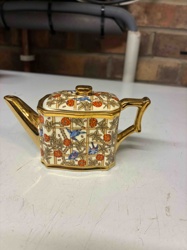
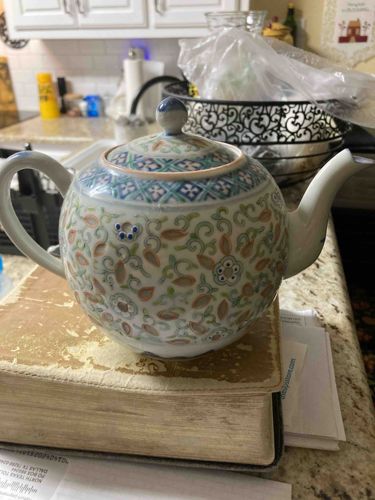
Asian-Style Floral and Geometric Pattern Teapot

Teapot

AI Estimated Value

·Not an official valuation·Verify before acting

$30-60

As of June 6, 2026

AI Item Analysis

·AI can make mistakes·Verify before acting
This is a ceramic teapot, likely porcelain or stoneware, featuring a vibrant and intricate hand-painted or transferware design. The main body of the teapot is globular, transitioning to a more flattened, rounded top. It has a high-arched C-shaped handle and a delicate, tapering spout. The color palette primarily includes a light cream or off-white base, adorned with patterns in muted blue, rust orange, and sage green, with occasional dark blue or black accents. The body is decorated with a scrolling floral and foliate motif, interspersed with stylized four-petal floral medallions. The shoulder of the teapot and the lid feature a contrasting geometric band, possibly a lattice or Greek key-inspired design, bordered by a thin rust-colored line. The lid is domed with a small, rounded finial, painted in blue and white. The construction appears to be machine-made but likely finished with hand-applied decoration, indicating a mid-range quality. There are no visible chips, cracks, or significant wear in the provided image, suggesting good overall condition. No specific maker's marks or signatures are discernable. Given the style, it likely dates from the late 20th century to early 21st century, embodying an Asian-inspired aesthetic often seen in decorative household items. The craftsmanship appears competent, with a generally smooth glaze and well-defined patterns.
AI Appraisal Report

·AI can make mistakes·Verify before acting
Based on my visual examination of the provided image, this Asian-Style Floral and Geometric Pattern Teapot appears to be in good overall condition, with no visible chips, cracks, or significant wear. The design suggests a late 20th to early 21st-century production, characterized by a hand-painted or transferware decoration over a likely machine-made ceramic body, consistent with mid-range decorative household items. While the craftsmanship is competent with well-defined patterns and a smooth glaze, the lack of specific maker's marks or discernible hand-painting details limits its value. In the current market, similar Asian-inspired decorative teapots, often mass-produced or semi-handfinished, fetch modest prices. Comparables found in online marketplaces and antique shops typically range from $25 to $75, depending on the intricacy of the design and perceived quality. This item does not exhibit characteristics of rare or historically significant pieces, nor does it appear to be from a renowned manufacturer, thus demand is primarily driven by its aesthetic appeal as a decorative or functional household item rather than its collectible value. Factors impacting its value include its good condition and pleasing design. However, the apparent machine-made base, lack of definitive age, and absence of identifiable provenance or maker reduce its potential as an investment piece. It is crucial to note that this assessment is based solely on visual inspection of an image. For full authentication and a more precise valuation, an in-person examination would be necessary to assess the quality of the ceramic body, confirm the decoration method (hand-painted vs. transferware), identify any faint maker's marks, and ascertain the true age through haptic and detailed visual inspection. Provenance documentation or scientific testing (e.g., thermoluminescence for age) could further solidify its authenticity and value, but these are rarely applied to items of this estimated value range.

Get your items appraised

Instant estimates of your treasures with AI-powered appraisals

Browse More Appraisals