AI estimate as of November 9, 2025 · verify with a professional before acting
AI-Generated · Verify before acting
Everything on this page is generated by AI for informational purposes only. AI can make mistakes — the AI may misidentify items or misattribute them (artist, maker, brand, designer, origin, era). This is not an official valuation and should not be used for insurance, sale, tax, estate, legal, or lending purposes — or any decision requiring a certified appraisal. It is not an authoritative claim about any person, brand, or rights holder — do not share or rely on it as a factual statement about a third party. Always consult qualified professionals before making financial decisions.
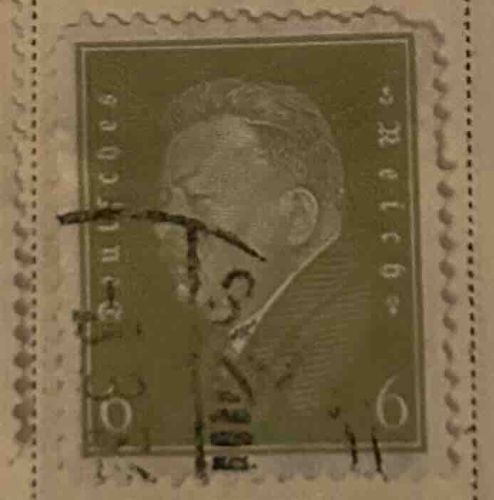
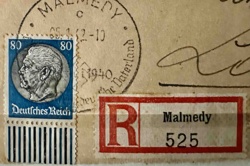
This item is a historical German postage stamp, likely from the Hindenburg Inaugural Issue series, identifiable by the profile portrait of Paul von Hindenburg, a prominent German statesman. The stamp measures approximately 2.5 cm by 3 cm, based on standard stamp dimensions, and is rendered in a muted olive-green or grayish-green monochrome on what appears to be off-white or cream-colored paper. The edges are perforated, a typical characteristic of postage stamps, indicating it was designed to be separated from a sheet.
Several German words are visible along the left and right borders of the portrait, though difficult to fully decipher due to the image quality and angle. The upper right text seems to include "Reich," possibly referring to the German Reich. Numerical values are also present, with a '30' clearly visible in the lower left corner and a '6' in the lower right, which could denote the stamp's denomination in Pfennig or Mark. The stamp's surface exhibits a postmark, which is a dark, irregularly shaped marking applied by postal services to cancel the stamp and prevent reuse. This specific postmark appears to be a partial circular or oval shape with additional straight line markings, typical of a hand-applied cancellation, and features the number '3' prominently within it, along with other unidentifiable characters and partial dates. The quality of printing appears consistent with early to mid-20th-century philately, showing a decent level of detail in the portrait despite the monochrome palette. The overall condition suggests moderate use and age, with the postmark attesting to its circulation. There are no evident tears or significant creases beyond what the postmark obscures, though the paper may show some age-related toning. The precise age would depend on the issue date of the Hindenburg series, which typically falls within the Weimar Republic or early Nazi Germany period.
AI Appraisal Report
I have examined the provided image of the German postage stamp, which appears to be from the Hindenburg Inaugural Issue. Visually, the stamp is consistent with genuine examples of this series. The profile portrait of Paul von Hindenburg is clear, and the perforations are present. The visible numerals '30' and '6' likely denote a denomination. The postmark, a prominent feature, indicates it was used, which generally reduces its value compared to an unused, no-hinge (MNH) example. While the postmark itself appears authentic for the period, its partial clarity makes full identification difficult from the image alone.
Based on the visual evidence, the stamp is in moderately good condition for a used item of its age. There are no obvious tears or significant creases beyond the postmark area, and the paper seems to show typical age-related toning. However, the image quality limits a definitive assessment of paper condition, potential thinning, minor faults, or hidden creases.
From a market perspective, Hindenburg Inaugural Issue stamps are generally quite common, especially used examples. While the series celebrates a significant historical figure, the individual stamps are not considered rare unless they possess specific varieties (e.g., printing errors, rare cancellations, or specific watermarks), which cannot be determined from this image. Demand for common used examples is moderate among general collectors of German philately, but not exceptionally high.
The most significant factor impacting its value is its used condition with a common postmark. Without a clear and desirable cancel, or evidence of a rare variety, the value remains modest. To definitively authenticate and provide a more precise valuation, a physical in-hand examination would be crucial. This would allow me to verify the paper type, gum (if unused, though this is used), exact perforation count, watermark (if any), and a more detailed assessment of the postmark's clarity and potential rarity. Provenance documentation, though less critical for common stamps, would also be beneficial for full authentication and history.