AI estimate as of October 21, 2025 · verify with a professional before acting
AI-Generated · Verify before acting
Everything on this page is generated by AI for informational purposes only. AI can make mistakes — the AI may misidentify items or misattribute them (artist, maker, brand, designer, origin, era). This is not an official valuation and should not be used for insurance, sale, tax, estate, legal, or lending purposes — or any decision requiring a certified appraisal. It is not an authoritative claim about any person, brand, or rights holder — do not share or rely on it as a factual statement about a third party. Always consult qualified professionals before making financial decisions.
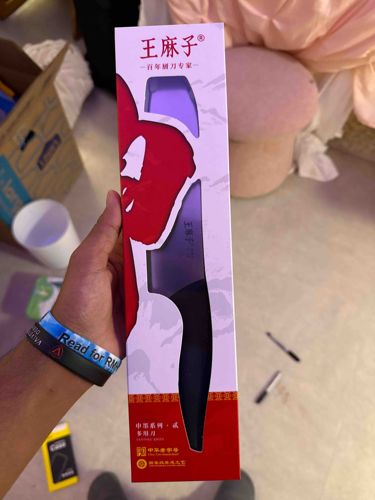
The item is a brand new, packaged kitchen knife, specifically from the 'Wang Mazhi' (王麻子) brand, which is prominently displayed in red Chinese characters at the top of the white and red cardboard box. Below the brand name, smaller characters state '百年制刀专家' which translates to 'Centennial Knife Expert' or 'Expert in a Hundred Years of Knife Making', suggesting a long history or tradition. The packaging features a striking design with a large, stylized red graphic that appears to be a traditional Chinese character or artistic representation, and a die-cut window through which the blade and handle of the knife are partially visible. The knife itself has a dark, possibly black or dark grey, blade and a similarly colored, contoured handle, implying a modern aesthetic. The handle appears ergonomic with a gentle curve, designed for comfortable grip. The visible part of the blade shows a subtle sheen, which could indicate a non-stick coating or a specific finish. On the lower section of the box, additional Chinese text is present, including '中厨系列.威 多用刀' which means 'Chinese Chef Series. Potent Multi-purpose Knife', and '中国中华老字号' which translates to 'China's Time-Honored Brand'. There is also a small gold circular emblem, likely a logo or certification mark for the 'Time-Honored Brand'. The overall packaging is clean and shows no signs of wear, tears, or damage, suggesting the item is in pristine, new condition. The construction of the box indicates it's designed for retail display. No visible manufacturing defects are apparent on the packaging or the visible parts of the knife. The item appears to be mass-produced, likely a consumer-grade kitchen tool, emphasizing its utility and brand heritage.
AI Appraisal Report
I have carefully examined the provided image of this Wang Mazhi (王麻子) Kitchen Knife in its original packaging. Visually, the item appears to be in pristine, brand-new condition, with the packaging showing no signs of wear, tears, or damage. The knife itself, as far as visible through the die-cut window, also appears flawless, suggesting no manufacturing defects. Authenticity, based solely on the visual cues, seems high; the prominent 'Wang Mazhi' branding, the '百年制刀专家' ('Centennial Knife Expert') claim, and the '中国中华老字号' ('China's Time-Honored Brand') emblem all point to a genuine product from a reputable Chinese brand. However, without a physical inspection, I cannot verify the quality of the materials (steel type, handle composition) or the sharpness of the blade.
Market conditions for mass-produced kitchen knives of this type are competitive. Comparables typically fall into the budget to mid-range segment for home kitchen use. While the 'Time-Honored Brand' designation adds a layer of heritage, it doesn't translate into significant collector's value for a utilitarian item like this. Demand is steady for practical kitchen tools, but there's no rarity to speak of; these are mass-produced. The primary value drivers are its new, unused condition, brand recognition within Chinese markets, and functional utility. Factors that could lower value would be any hidden defects, a poor steel quality, or significant flaws upon physical inspection. For full authentication and a more precise value, an in-person examination would be critical to assess blade material, handle ergonomics, overall balance, and confirm the absence of any hidden defects. Provenance documentation is not typically required for items of this nature.