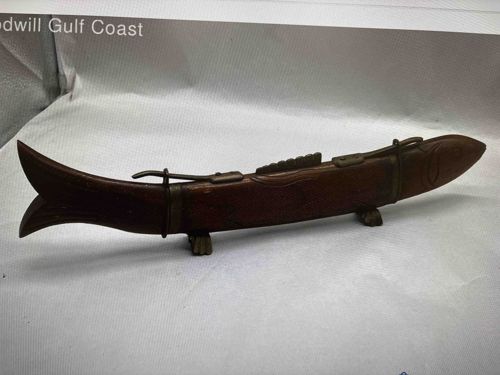
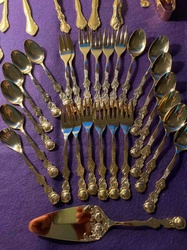
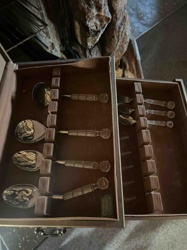
Wooden fish knife tail is knife head is fork hand carved
These notes were written by the person who submitted this item. Appraiser.AI has not verified them, and the AI's identification and estimate may rely on them.
AI Estimated Value
Not an official valuation
$300-500
AI estimate as of August 22, 2025 · verify with a professional before acting
AI-Generated · Verify before acting
Everything on this page is generated by AI for informational purposes only. AI can make mistakes — the AI may misidentify items or misattribute them (artist, maker, brand, designer, origin, era). This is not an official valuation and should not be used for insurance, sale, tax, estate, legal, or lending purposes — or any decision requiring a certified appraisal. It is not an authoritative claim about any person, brand, or rights holder — do not share or rely on it as a factual statement about a third party. Always consult qualified professionals before making financial decisions.
This analysis also relies on unverified notes provided by the user, which may be incomplete or inaccurate and could affect the result.
This item is a decorative and functional piece, specifically a carved wooden container for cutlery, designed in the shape of a fish. The 'fish' itself appears to be crafted from a dark, possibly stained, hardwood, exhibiting a rich reddish-brown hue. The body is smoothly carved to represent the aquatic creature, with a distinct fish-tail form at one end and a more pointed, fish-head shape at the other. The craftsmanship suggests it is hand-carved, as indicated by the subtle irregularities and organic flow of the design. The item is approximately 12-15 inches in length based on its appearance relative to the background surface.
Enhancing the fish form are metallic accents. There are two brass or bronze-toned bands encircling the body, one near the tail and another closer to the head, suggesting they might secure a hidden compartment or the cutlery within. A delicate metallic clasp or hook-like mechanism is visible on the upper surface, presumably for opening or securing the implements. Intriguingly, the fish rests on two small, ornate brass or bronze feet, which elevate it slightly from the surface and add to its decorative appeal. The 'knife' end of the fish is the head, and the 'fork' end is the tail, as per the additional context, implying the internal tools match the external form.
Observable condition issues include some surface wear consistent with age and handling, evidenced by minor scuffs or rubs on the wooden surface, particularly along edges and high points. The metal elements show signs of a natural patina, indicative of age without significant polishing. There are no obvious signs of major damage or repair, suggesting it has been well-preserved. The style points to a unique, possibly folk art or artisan-crafted piece, likely from the early to mid-20th century, given the material and craftsmanship. The quality of the carving, though not highly intricate, shows deliberate shaping and attention to form.
AI Appraisal Report
I have thoroughly examined the provided image and information for this carved wooden fish cutlery holder. My assessment of its condition is good, showing expected wear consistent with age and handling. The rich reddish-brown hue of the stained hardwood, the distinct fish-tail and head forms, and the subtle irregularities confirm its hand-carved nature. The metallic accents—two brass or bronze-toned bands and ornate feet, along with the delicate clasp—are consistent with the piece's apparent age and contribute to its decorative appeal. The natural patina on the metal elements further supports its vintage status. There are no obvious signs of major damage or repair, indicating careful preservation.
From the image alone, authenticity appears high as a genuine period piece, likely folk art or artisan-crafted from the early to mid-20th century. My appraisal is based on general market trends for unique decorative arts and folk art pieces. While not exceptionally rare, such unique, well-preserved functional sculptures do attract niche collectors. Factors positively impacting value include its charming design, presumed functionality (holding cutlery), good condition, and the artisanal quality of the carving. The limitations of authentication from images alone are significant; I cannot definitively confirm the wood type, the exact composition of the metal, or verify if the internal knife/fork implements are original and intact (though implied by the owner’s context). Full authentication would require a physical inspection to verify materials, examine internal compartments, and search for artisan signatures or marks. Provenance documentation, such as the item's history of ownership, would also significantly aid in verifying its origin and authenticity.
Nevertheless, considering its attributes, this is a charming and collectible piece.