AI estimate as of June 21, 2025 · verify with a professional before acting
AI-Generated · Verify before acting
Everything on this page is generated by AI for informational purposes only. AI can make mistakes — the AI may misidentify items or misattribute them (artist, maker, brand, designer, origin, era). This is not an official valuation and should not be used for insurance, sale, tax, estate, legal, or lending purposes — or any decision requiring a certified appraisal. It is not an authoritative claim about any person, brand, or rights holder — do not share or rely on it as a factual statement about a third party. Always consult qualified professionals before making financial decisions.
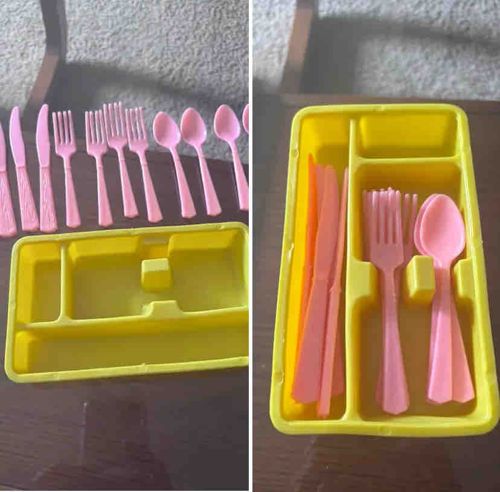
This item is a children's plastic utensil set, likely from the mid-20th century, possibly the 1970s or 1980s, given its simplistic design and material choice. The set consists of multiple pieces of cutlery "knives, forks, and spoons" all rendered in a cheerful, uniform shade of pink plastic. The knives have a distinctly blunt, safety-oriented edge, indicating they are designed for young children. The forks feature four widely spaced tines, and the spoons have a shallow, rounded bowl. All pieces share a similar handle design, flaring slightly towards the end. The set comes with a bright yellow plastic organizer tray, which has multiple compartments designed to hold and separate the different types of cutlery. The tray features a long central compartment for the knives, and two shorter, wider compartments for the forks and spoons. There are no obvious wear or damage visible, suggesting either light use or good preservation. The plastic material appears to be in good condition, without significant discoloration or scratches. There are no discernible manufacturer's marks or distinguishing features that would indicate a specific brand or maker. The simplicity and uniform color scheme are typical of children's play or dining sets from the estimated period, prioritizing durability and ease of cleaning. The overall quality appears to be functional and recreational rather than high-end, characteristic of mass-produced plastic items.
AI Appraisal Report
I have examined the provided image of the Children's Pink Plastic Cutlery Set with Yellow Tray. Based on visual assessment, the condition appears excellent, with no visible wear, discoloration, or scratches on either the pink cutlery or the yellow tray. This suggests either minimal use or meticulous preservation. Authenticity, based solely on imagery, is challenging; however, the design aligns with common mass-produced children's plastic items from the mid-20th century, likely 1970s or 1980s, as suggested. I see no anomalies that would indicate it is not authentic to that period.My valuation considers market conditions for vintage plastic children's items. While there's a niche market for nostalgic toys and dinnerware, items lacking specific brand recognition or significant historical importance typically do not command high prices. Comparable sets, often sold as part of larger play kitchen sets or as standalone novelty items, generally retail in the lower range.Demand for unbranded plastic cutlery sets is relatively low, making this item more of a charming collectible than a sought-after antique. Its rarity is not exceptionally high given the mass production methods of the era. The primary factors impacting its value are its excellent condition and its charming, nostalgic appeal. Without manufacturer's marks, pinpointing a specific origin or verifying any claims of limited production is impossible.For full authentication, an in-person examination would be critical to assess the plastic's tactile quality, precise manufacturing techniques, and to search for any subtle, unphotographed markings. Provenance documentation, such as original sales receipts or family history, would also significantly aid in authenticating its age and origin, but this is unlikely for such an item. Scientific testing, while possible for material analysis and age verification, would be cost-prohibitive given the item's inherent value. Therefore, this appraisal is based purely on visual cues and general market trends for comparable unbranded vintage plastic items.