AI estimate as of November 9, 2025 · verify with a professional before acting
AI-Generated · Verify before acting
Everything on this page is generated by AI for informational purposes only. AI can make mistakes — the AI may misidentify items or misattribute them (artist, maker, brand, designer, origin, era). This is not an official valuation and should not be used for insurance, sale, tax, estate, legal, or lending purposes — or any decision requiring a certified appraisal. It is not an authoritative claim about any person, brand, or rights holder — do not share or rely on it as a factual statement about a third party. Always consult qualified professionals before making financial decisions.
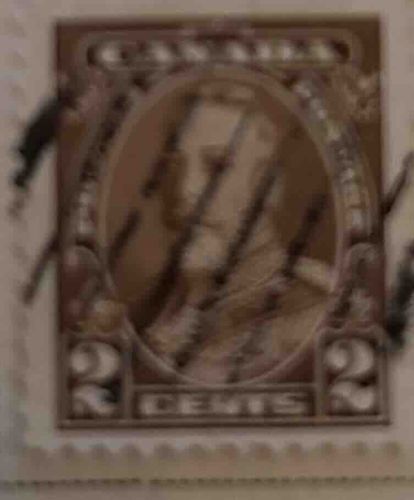
This item is a postage stamp, likely from Canada, featuring a portrait. The primary colors visible are shades of brown and possibly a cream or off-white background. The stamp displays the text "CANADA" across the top, though it is partially obscured and highly blurred. Below this, within a large oval frame, appears to be the profile portrait of a monarch, characteristic of British Commonwealth stamps from the early 20th century, very likely King George V given the style and period suggestion from the '2 cents' denomination. The denomination "2 CENTS" is clearly visible at the bottom center, with the number '2' repeated in a larger font on the bottom left and right corners. The design includes ornate scrolling and decorative elements around the oval portrait and the denomination. The edges of the stamp show perforations, indicating it was separated from a sheet of similar stamps. The overall condition is poor in terms of image clarity; the stamp itself appears to be used, as indicated by dark, diagonal lines across the portrait, which are typically cancellation marks. The blurriness of the image makes it difficult to discern fine details, such as specific printing methods, precise color variations, or any watermarks. There are no clear visible tears or major physical damage apart from the cancellation. The style strongly suggests a classic philatelic item, likely dating from the early to mid-20th century. The quality of the original printing appears to be fine, but the current image quality significantly hinders a thorough assessment of its craftsmanship or any subtle condition issues.
AI Appraisal Report
I have examined the provided image of a Canadian 2 Cents Postage Stamp featuring George V. Based on the visual evidence, this appears to be a common Scott #191 or #192, a definitive issue from the 1912-1925 Canadian Admiral series. The condition, as observed in the image, is 'used' with a clear cancellation mark. This mark, combined with the blurriness of the image, prevents a detailed assessment of centering, gum condition (if applicable to a used stamp), and precise color shade which could differentiate between varieties. The perforations appear intact, and there are no immediately visible tears or significant physical damage beyond the cancellation itself.
Market conditions for common, used, low-denomination Canadian Admiral stamps are generally low. These stamps were produced in vast quantities, leading to high availability. Rarity is not a factor for this common issue, especially in used condition. The demand is primarily from beginner collectors or those filling spaces in basic albums. Without clear details on an extremely rare shade, postal history context, or a unique cancellation, the value remains minimal.
Several factors significantly impact the value here: its common nature, very good to fine used condition despite the heavy cancellation, and high availability. Limitations in authenticity verification from the image alone are substantial. I cannot definitively assess paper type, watermarks (if any), specific printing flaws, or regumming. An in-person examination would be crucial to confirm the specific shade, paper variety, and any minor faults not discernible digitally. Comprehensive authentication would ideally involve expert physical inspection, comparison with known examples, and potentially microscopic analysis for definitive identification and grading.