These notes were written by the person who submitted this item. Appraiser.AI has not verified them, and the AI's identification and estimate may rely on them.
AI Estimated Value
Not an official valuation
$30 - $70
AI estimate as of August 31, 2025 · verify with a professional before acting
AI-Generated · Verify before acting
Everything on this page is generated by AI for informational purposes only. AI can make mistakes — the AI may misidentify items or misattribute them (artist, maker, brand, designer, origin, era). This is not an official valuation and should not be used for insurance, sale, tax, estate, legal, or lending purposes — or any decision requiring a certified appraisal. It is not an authoritative claim about any person, brand, or rights holder — do not share or rely on it as a factual statement about a third party. Always consult qualified professionals before making financial decisions.
This analysis also relies on unverified notes provided by the user, which may be incomplete or inaccurate and could affect the result.
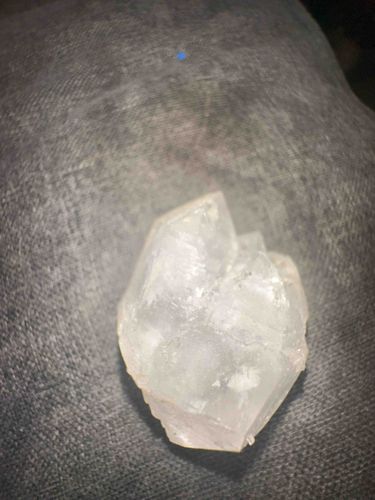
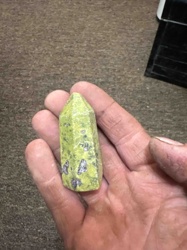
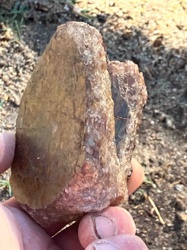
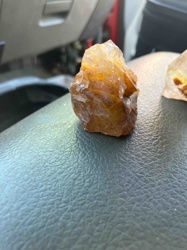
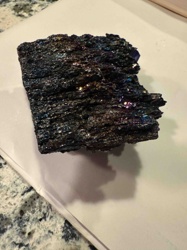
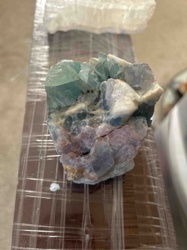
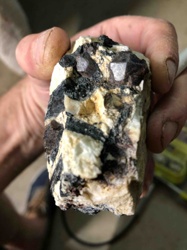
The item is a raw, unpolished crystal specimen, most likely a form of quartz given its translucent to semi-transparent appearance and observed crystalline structure. It exhibits clear, hexagonal prism faces with pyramidal terminations characteristic of quartz, though some faces appear less defined due to natural growth variations or minor breakage. The crystal is irregularly shaped, suggesting it may be a fragment of a larger geode or a single terminated point. Its color is primarily colorless to very light, milky white, with some areas appearing more opaque due to internal inclusions or cloudiness. The surface texture is generally smooth on the crystal faces, but there are visible rough areas, particularly along the edges and where it presumably detached from its matrix. Some facets show a natural luster, indicating a relatively clean and intact surface. There are no obvious signs of significant damage like large chips or repairs, but minor natural imperfections, such as small nicks or growth marks, are present. No manufacturing marks, signatures, or specific maker's details are discernible as it is a natural mineral. Based on its raw state, it is a natural geological formation, with an estimated age in the millions of years, though its extraction and handling would be more recent. The quality appears to be that of a standard collector's specimen, not gem-grade, but possessing clear crystal forms that make it visually interesting. Its craftsmanship is solely nature's own, showcasing the inherent beauty and structural integrity of a mineral.
AI Appraisal Report
Based on my visual examination of the provided image and your description, this Natural Quartz Crystal Specimen appears to be an authentic, raw, and unpolished quartz crystal. Its clear hexagonal prism faces and pyramidal terminations are characteristic of natural quartz formations. The colorless to milky white coloration and internal cloudiness are common for such specimens. I assess its condition as good for a natural specimen, with typical minor nicks and growth marks, confirming its raw state without signs of repair or significant damage. It is clearly a natural geological formation.
In terms of market conditions, natural quartz specimens, while popular, are not inherently rare, especially those that are not gem-grade. Larger, clearer, or more uniquely formed specimens command higher prices. Comparables in the market for similar raw quartz points of this apparent size and quality typically range from $30 to $70. Factors impacting this value include its raw state (not cut or polished), the presence of inclusions/cloudiness, and its status as a collector's specimen rather than gem material. While there is consistent demand for natural crystals, this specific type isn't considered rare enough to drive a premium price, nor does it possess exceptional clarity or size.
A significant limitation in this appraisal is the reliance on images alone for authenticity verification and detailed quality assessment. A full in-person examination would allow for precise measurement, clearer assessment of luster, surface texture, and the true extent of internal inclusions or fractures. For ultimate authentication, especially if there were questions about its origin or if it were presented as a particularly rare find, scientific testing such as X-ray diffraction (XRD) or Raman spectroscopy to confirm mineral composition would be beneficial. Provenance documentation, detailing where and when it was found or purchased, would also add to its historical value, though it rarely impacts the market value of common quartz specimens.