AI estimate as of November 4, 2025 · verify with a professional before acting
AI-Generated · Verify before acting
Everything on this page is generated by AI for informational purposes only. AI can make mistakes — the AI may misidentify items or misattribute them (artist, maker, brand, designer, origin, era). This is not an official valuation and should not be used for insurance, sale, tax, estate, legal, or lending purposes — or any decision requiring a certified appraisal. It is not an authoritative claim about any person, brand, or rights holder — do not share or rely on it as a factual statement about a third party. Always consult qualified professionals before making financial decisions.
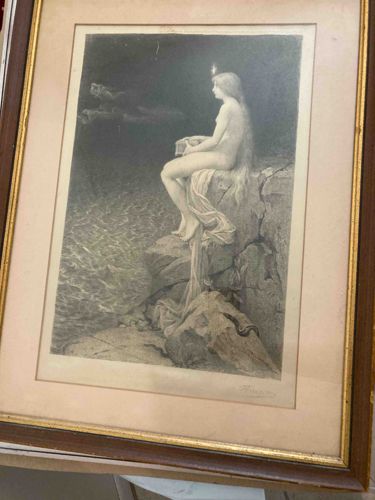
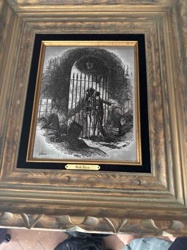
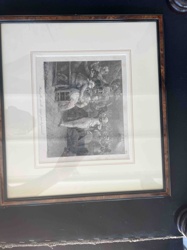
This item is a framed allegorical engraving, likely titled 'Pandora Opening the Box' or a similar theme. The central figure is a nude woman, presumed to be Pandora, with long flowing hair, seated on a rugged rock formation. She cradles a small, rectangular box in her hands, from which a faint light or wisp of smoke seems to emanate, subtly illuminating her head. Her gaze is directed upwards and outwards, suggesting a moment of contemplation or realization regarding the contents she is about to release. The background depicts a turbulent body of water, possibly the sea or raging waves, adding a dramatic and ominous atmosphere. To the right of the figure, a serpent is visible curled around the base of the rock, a significant symbol often associated with temptation or evil in the Pandora myth. The engraving exhibits fine detail work, particularly in the rendering of the woman's form, her hair, the texture of the rock, and the movement of the water. The print is presented within a mat board, which appears to be ecru or a light cream color, and housed in a wooden frame. The frame has a darker, possibly walnut-stained, outer profile with an inner gilded or gold-colored trim. Visible condition issues include some discoloration or foxing on the mat board, especially along the top and right edges, as well as some surface inconsistencies or dust particles on the print itself, potentially under the glass. The frame shows minor wear consistent with age, such as small nicks or scuffs. The style and subject matter suggest a print from the late 19th or early 20th century, a period when allegorical and mythological themes were popular in art. Although no clear manufacturing marks or a signature are fully discernible from the provided images, the artistic style points to classical influences, executed with a high level of technical skill in engraving.
AI Appraisal Report
Based on my visual examination of the provided image, this Pandora Opening the Box allegorical engraving is a compelling piece. The fine detail in the engraving, depicting the nude figure of Pandora, the turbulent water, and the symbolic serpent, suggests a high level of technical skill. The allegorical and mythological theme aligns with artistic trends of the late 19th or early 20th century. Condition-wise, I note visible foxing and discoloration on the mat board, especially along the top and right edges, alongside some surface inconsistencies on the print itself. The frame, a darker wood with a gilded inner trim, shows minor wear consistent with its age. These condition issues will impact desirability and value.
Market conditions for allegorical engravings are generally stable, with a moderate demand for well-executed pieces from this period. While not considered rare, the quality of the engraving and the enduring popularity of the Pandora myth provide a baseline value. Comparable sales for similar unframed allegorical engravings by lesser-known artists typically range from $75 to $200. The framing, despite minor wear, adds to the presentability, increasing its appeal.
My primary limitation in this appraisal is the lack of in-person examination. Without physical inspection, I cannot ascertain the exact printmaking technique (e.g., etching, mezzotint), paper quality, or true extent of discoloration. Crucially, I cannot verify the presence of a signature, printer's mark, or edition number, which would significantly impact authenticity and value. A physical examination, potentially under magnification, and research into the print's provenance (if available) would be necessary to fully authenticate its origin and potentially attribute it to a specific artist or workshop, thus firming up its value within the fine art market. Without these, it remains a decorative art piece of good quality.