These notes were written by the person who submitted this item. Appraiser.AI has not verified them, and the AI's identification and estimate may rely on them.
AI Estimated Value
Not an official valuation
$200-400
AI estimate as of November 23, 2025 · verify with a professional before acting
AI-Generated · Verify before acting
Everything on this page is generated by AI for informational purposes only. AI can make mistakes — the AI may misidentify items or misattribute them (artist, maker, brand, designer, origin, era). This is not an official valuation and should not be used for insurance, sale, tax, estate, legal, or lending purposes — or any decision requiring a certified appraisal. It is not an authoritative claim about any person, brand, or rights holder — do not share or rely on it as a factual statement about a third party. Always consult qualified professionals before making financial decisions.
This analysis also relies on unverified notes provided by the user, which may be incomplete or inaccurate and could affect the result.
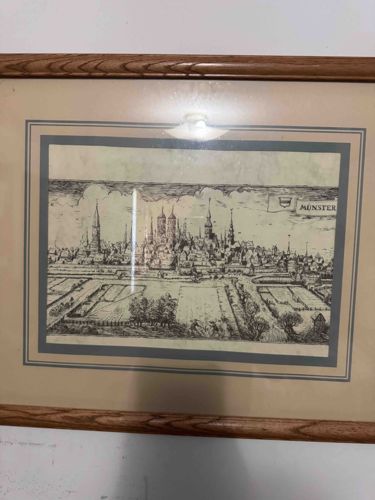
This item is a framed engraving or print depicting a panoramic cityscape of "Münster," as indicated by the text in the upper right corner of the print itself. The image is rendered in a monochromatic palette, likely black ink on a light-colored paper, which has acquired an age-appropriate patination, appearing light beige or off-white. The print showcases a detailed view of the city with numerous spires, roofs, and urban structures, characteristic of historical European city views. In the foreground, there are cultivated fields or gardens, suggesting an early modern or medieval period representation of the urban landscape. The artistic style appears to be a fine line engraving or woodcut, demonstrating intricate detail in architectural elements, foliage, and distant clouds. The print is housed within a light-colored, possibly cream or beige, mat board that features a double border accent in a muted blue-gray tone, providing a visual separation from the print to the frame. The frame itself is made of wood, exhibiting a natural grain and a medium brown, possibly oak, finish. The frame appears to be in good condition with minor surface wear consistent with age and handling. There is a noticeable glare on the glass covering the print, making it difficult to assess the exact condition of the print underneath, though no obvious tears or significant damage are visible from the image provided. The overall presentation suggests a historical piece, likely dating from the 19th or early 20th century, if not an earlier reproduction of a much older work. The craftsmanship of the engraving itself appears to be of good quality, with fine lines and intricate shading. The framing also suggests a certain level of care in presentation.
AI Appraisal Report
I have examined the provided image of the framed engraving or print depicting a panoramic cityscape of "Münster." The piece presents as a historical European urban view, likely rendered in black ink on aged paper, exhibiting a pleasant light beige patination. The intricate detail in architectural elements, foliage, and clouds suggests a fine line engraving or woodcut, indicative of good quality craftsmanship. The print is professionally matted with a double border and housed in a natural grain, medium brown wooden frame, which appears in good condition. The overall presentation is appealing, hinting at a 19th or early 20th-century piece, or an earlier reproduction.
Based on visual assessment alone, the print’s condition seems good, though glare on the glass obscures a precise evaluation of the print surface for foxing, tears, or significant discoloration. The framing adds to its display value. Demand for historical cityscapes, particularly from well-known European cities like Münster, remains steady, appealing to collectors of historical prints, urban art, and regional memorabilia. While the subject is desirable, such engravings were often produced in editions, impacting rarity.
Key limitations arise from the visual-only examination. Without physical inspection, the exact printing technique (engraving, etching, lithograph, or modern reproduction) cannot be definitively confirmed. This significantly impacts authenticity and value. The specific artist, publisher, and precise dating are also indeterminate. To fully authenticate and maximize value, an in-person examination by a print specialist is crucial to study paper quality, watermarks, plate marks, and printing methods. Provenance documentation, if available, would also be invaluable. My appraisal range reflects the uncertainty inherent in an image-based assessment, assuming it is an authentic period print. If it were confirmed as an early, rare engraving by a noted artist, the value could be significantly higher; conversely, a modern reproduction would fall at the lower end of or below this range.