AI estimate as of October 3, 2025 · verify with a professional before acting
AI-Generated · Verify before acting
Everything on this page is generated by AI for informational purposes only. AI can make mistakes — the AI may misidentify items or misattribute them (artist, maker, brand, designer, origin, era). This is not an official valuation and should not be used for insurance, sale, tax, estate, legal, or lending purposes — or any decision requiring a certified appraisal. It is not an authoritative claim about any person, brand, or rights holder — do not share or rely on it as a factual statement about a third party. Always consult qualified professionals before making financial decisions.
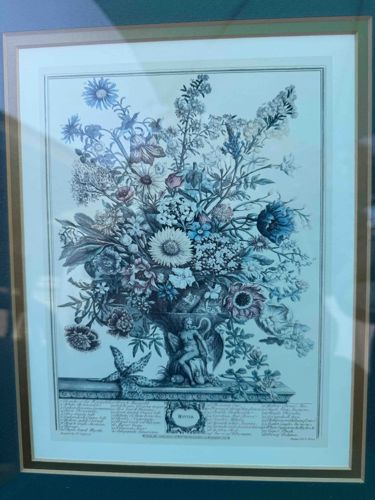
This item is a framed botanical engraving, likely hand-colored, depicting a dense and luxuriant arrangement of various flowers in a decorative urn. The dominant colors visible are muted blues, purples, greens, and soft pinks, suggesting either an older printing technique or a specific color palette choice. The engraving itself showcases fine line work and intricate detailing, characteristic of 18th or 19th-century botanical illustrations. The urn holding the bouquet is highly ornate, featuring a classical-style figure, possibly a putto or deity, seated on its base, and intricate scrollwork. Below the main image, there is a detailed inscription section with multiple columns of text, likely listing the names of the depicted flowers in Latin and perhaps their common names or botanical details, and a central cartouche with the title 'Bouquet'. The print is housed within a simple, light-colored wooden frame, possibly a natural wood tone or a light oak, with a white, acid-free mat providing a border between the print and the frame. The overall condition appears good, with no obvious signs of significant damage, tears, or discoloration to the print itself, though minor fading or slight yellowing due to age is possible and often expected in such pieces. The frame and mat also appear to be in good condition, showing general signs of age-appropriate wear but no severe scuffs or breaks. The item exudes a classic, educational, and decorative aesthetic, suggesting a style period rooted in the Enlightenment era's interest in natural history and scientific illustration, or a revival of such styles. The craftsmanship of the engraving is evident in the precision of the lines and the artistic arrangement of the flowers.
AI Appraisal Report
Based on my visual examination of the provided image, this framed botanical engraving, titled 'Bouquet,' appears to be a carefully rendered and likely hand-colored piece, characteristic of 18th or 19th-century botanical illustration. The fine line work, intricate detailing of both the flowers and the ornate urn, and the multi-columned inscription point towards a high degree of craftsmanship and scientific rigor indicative of the period. The muted color palette of blues, purples, greens, and soft pinks suggests either an older printing technique or deliberate artistic choice, enhancing its antique appeal.
The overall condition appears good, with no obvious major damage like tears, significant foxing, or creases visible in the image. Minor age-related fading or slight yellowing is to be expected with prints of this vintage and does not significantly detract unless excessive. The simple, light-colored wooden frame with a white acid-free mat is appropriate for displaying such a piece, and both appear in good, age-consistent condition.
Market demand for antique botanical engravings remains steady, particularly for well-executed and visually appealing pieces like this 'Bouquet.' Items with detailed inscriptions and an identifiable title tend to command higher prices. Comparables for hand-colored botanical engravings from renowned artists or publishers of the 18th-19th centuries typically range from a few hundred to several thousand dollars, depending on rarity, artist, subject, and condition. This piece falls into a desirable aesthetic niche, balancing scientific illustration with decorative appeal.
Factors impacting value positively include its apparent good condition, the detailed imagery, and the presence of descriptive text. As rarity cannot be fully assessed from a single image, I am unable to definitively comment on its uniqueness without further research into print catalogs or artist oeuvres.
LIMITATIONS: It is crucial to note that this appraisal is based solely on visual inspection of the image. For full authentication and a more precise valuation, a physical in-person examination is necessary. This would allow me to verify the authenticity of the hand-coloring techniques, assess the paper quality, examine for watermarks or plate marks, detect any hidden damage, confirm the print method, and accurately determine the exact age and provenance. Documentation of origin would significantly enhance its value by verifying the artist, publisher, and edition. Scientific testing might be employed to confirm paper age and pigment composition if questions of authenticity arise.