These notes were written by the person who submitted this item. Appraiser.AI has not verified them, and the AI's identification and estimate may rely on them.
AI Estimated Value
Not an official valuation
$5 - $15
AI estimate as of November 9, 2025 · verify with a professional before acting
AI-Generated · Verify before acting
Everything on this page is generated by AI for informational purposes only. AI can make mistakes — the AI may misidentify items or misattribute them (artist, maker, brand, designer, origin, era). This is not an official valuation and should not be used for insurance, sale, tax, estate, legal, or lending purposes — or any decision requiring a certified appraisal. It is not an authoritative claim about any person, brand, or rights holder — do not share or rely on it as a factual statement about a third party. Always consult qualified professionals before making financial decisions.
This analysis also relies on unverified notes provided by the user, which may be incomplete or inaccurate and could affect the result.
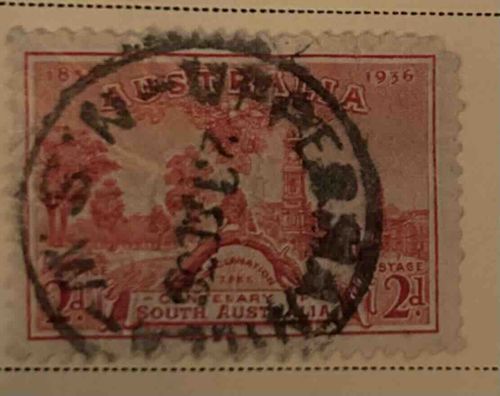
This is an Australian postage stamp issued in 1936 to commemorate the centenary of South Australia. The stamp is predominantly sepia and rose in color, featuring a detailed illustration within a rectangular frame. The design includes a landscape with trees, a sailing ship (possibly the HMS Buffalo, a key part of South Australia's history), and what appears to be a building in the background. The text 'AUSTRALIA' is visible across the top center, with the dates '1836' on the left and '1936' on the right, indicating the centenary period. The denomination '2 1/2d' (two pence halfpenny) is clearly displayed in the bottom right corner, and 'POSTAGE' above it. Additional text, 'SOUTH AUSTRALIA' and 'CENTENARY', is discernible towards the bottom central part of the stamp, though somewhat obscured by the postmark. The stamp has perforated edges, typical of postage stamps, and is affixed to what appears to be part of a philatelic page or album sheet, evidenced by the surrounding white paper and partial perforations of an adjacent stamp. A heavy, circular black postmark covers a significant portion of the stamp's central design, making some details difficult to ascertain, particularly any specific cancellation date or location. The postmark itself, however, has sharp edges around its circular form, suggesting a clear application. Despite the postmark, the colors retain their vibrancy, and the printing quality appears fine for its age. The overall condition, apart from the cancellation, appears to be good with no obvious tears or creases visible.
AI Appraisal Report
Upon examining the provided image of the Australia 1936 South Australia Centenary 2 1/2d Sepia and Rose Stamp, I assess its condition. The stamp exhibits good centering and the colors appear vibrant for its age. The perforations seem intact. However, the most significant factor affecting its value is the heavy, circular black postmark that covers a substantial portion of the central design. While the postmark appears clearly struck, its placement significantly detracts from the visual appeal and clarity of the stamp's features. No obvious tears or creases are visible, suggesting the paper itself is in decent shape.
From a market perspective, this is a relatively common commemorative issue. While authentic, the heavy cancellation typically places it at the lower end of the value spectrum for this particular stamp. Unused or lightly cancelled examples command higher prices. Demand for heavily cancelled common issues like this tends to be moderate, primarily from general collectors or those seeking to complete a 'used' collection. Rarity is low due to the large printing quantities.
Limitations of this appraisal include the inability to physically inspect the stamp for hidden flaws, paper quality, gum condition (if unused, though this is clearly used), or precise nuances of the postmark without an in-person examination. For full authentication and a more precise grading, a hands-on review by a philatelic expert is recommended. This would also allow for verification of any potential repairs or alterations that are not discernible from an image. My valuation reflects a genuine, heavily cancelled example of this issue.