AI estimate as of November 13, 2025 · verify with a professional before acting
AI-Generated · Verify before acting
Everything on this page is generated by AI for informational purposes only. AI can make mistakes — the AI may misidentify items or misattribute them (artist, maker, brand, designer, origin, era). This is not an official valuation and should not be used for insurance, sale, tax, estate, legal, or lending purposes — or any decision requiring a certified appraisal. It is not an authoritative claim about any person, brand, or rights holder — do not share or rely on it as a factual statement about a third party. Always consult qualified professionals before making financial decisions.
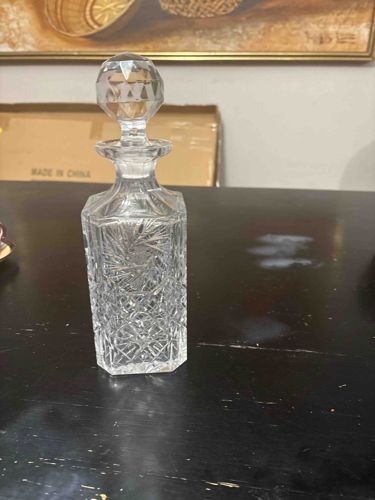
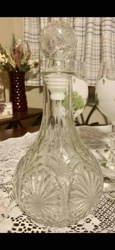
This is a clear glass or crystal decanter, featuring a multi-faceted design throughout its body, characterized by a repeating pattern of cut geometric shapes, likely starbursts and cross-hatching, suggesting a pressed or cut glass construction. The decanter has a rectangular or square base that tapers slightly upwards towards a narrower neck. The base itself appears to be octagonal or hexagonal from the bottom view. The stopper is prominent, made of the same clear material, and displays a large, faceted, spherical or domed top, resembling a crystal ball, fitting into the neck of the decanter. The overall style suggests an antique or vintage piece, possibly dating from the late 19th to mid-20th century, consistent with the popular designs of the Brilliant Cut Glass era or similar patterns. The craftsmanship appears to be of decent quality, with clean cuts and a sparkling appearance. No obvious chips, cracks, or significant damage are visible from the provided images, though a full inspection would be required to confirm. The clarity of the material and the intricate cutting indicate a decorative as well as functional purpose, likely for serving spirits. There are no discernible maker's marks or signatures visible from the provided images. The background suggests it is placed on a dark wooden surface, possibly a dining table or sideboard, and a framed picture is in the background.
AI Appraisal Report
I have examined the provided image of the Crystal Decanter with Faceted Stopper. Based on its visual characteristics, I assess this item to be a vintage pressed or cut glass decanter, likely dating from the mid-20th century. The multi-faceted design, featuring geometric cuts, suggests a common decorative style rather than high-end Brilliant Cut Glass, which typically exhibits sharper, more intricate hand-cut patterns. The condition appears good from the image, with no obvious chips, cracks, or significant damage. However, a full inspection for flea bites, internal cloudiness, or repair would require a physical examination.
Authenticity: While it presents as a crystal decanter, without physical inspection or testing (such as a refractometer for lead content), I cannot definitively confirm it is lead crystal. It could be high-quality pressed glass. The absence of maker's marks, which is common for many such pieces, limits definitive attribution. For full authentication and material verification, an in-person examination is crucial.
Market Conditions & Comparables: The market for vintage decanters of this style is generally stable but not experiencing significant appreciation. Similar decanters, whether crystal or high-quality pressed glass, are readily available across various online platforms and antique shops. Demand is moderate, driven by collectors of barware or individuals seeking decorative accessories. Rarity is low, as designs of this type were mass-produced. Factors impacting value include the actual material (lead crystal vs. glass), the precision of the cuts (hand-cut vs. machine-pressed), and any maker's marks, none of which can be definitively confirmed from the image alone. The lack of distinctiveness or high-end craftsmanship visible in the image limits its potential for higher valuation.