These notes were written by the person who submitted this item. Appraiser.AI has not verified them, and the AI's identification and estimate may rely on them.
AI Estimated Value
Not an official valuation
$120 - $200
AI estimate as of August 31, 2025 · verify with a professional before acting
AI-Generated · Verify before acting
Everything on this page is generated by AI for informational purposes only. AI can make mistakes — the AI may misidentify items or misattribute them (artist, maker, brand, designer, origin, era). This is not an official valuation and should not be used for insurance, sale, tax, estate, legal, or lending purposes — or any decision requiring a certified appraisal. It is not an authoritative claim about any person, brand, or rights holder — do not share or rely on it as a factual statement about a third party. Always consult qualified professionals before making financial decisions.
This analysis also relies on unverified notes provided by the user, which may be incomplete or inaccurate and could affect the result.
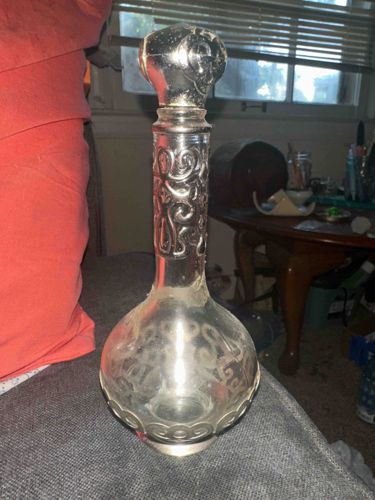
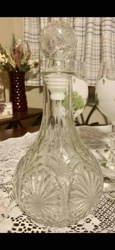
This is a vintage clear glass decanter, likely used for spirits or wine, distinguished by its ornate silver-tone metal cladding. The decanter features a baluster-shaped body, with a more globular, rounded base that gradually tapers upwards into a slender neck. The lower half of the globular base is encircled by a band of relief-molded or applied metalwork, featuring a repeating scrolled or circular motif, possibly reminiscent of an 'Ogee' pattern. The majority of the slender neck is encased in silver-toned metal, intricately decorated with flowing, organic scrollwork and foliate designs. This highly ornate section extends from where the neck narrows from the base almost up to the stopper. The stopper itself is large and bulbous, appearing to be solid metal or heavily metal-clad glass, with a rounded dome top and a faceted or slightly sculpted surface, fitting securely into the decanter's opening. The clear glass component of the decanter, visible through the metalwork and at the very bottom, exhibits some haziness or internal residue, suggesting it has been used and not recently cleaned. There might be some light surface scratches or wear commensurate with its age and use. The metalwork shows some dullness or minor tarnishing, but no significant dents or damage are immediately apparent. The overall design suggests a late 19th to early 20th-century aesthetic, possibly Art Nouveau influenced due to the flowing organic patterns. The craftsmanship appears to be commercial grade, indicative of mass production for decorative and utilitarian purposes, rather than bespoke artisan work. The presence of the intricate metal overlay significantly enhances its decorative appeal.
AI Appraisal Report
Based on my visual examination of the provided image, this Vintage Ornate Silver-Tone Clad Glass Decanter presents as a charming decorative piece. The baluster-shaped clear glass body with its intricate silver-tone metal cladding, featuring scrollwork and foliate designs, strongly suggests a late 19th to early 20th-century aesthetic, likely influenced by the Art Nouveau movement. The large, bulbous metal stopper completes its stately appearance.
From a condition standpoint, the visible haziness and internal residue within the glass indicate previous use and suggest a need for thorough cleaning. This, along with minor tarnishing on the metalwork, is consistent with its vintage nature. I don't observe any significant dents or major damage to the metal, which bodes well. However, without a physical inspection, it's impossible to conclusively identify hairline cracks in the glass hidden by the metalwork, or the extent of any internal etching or sickness that might not resolve with cleaning. Similarly, the exact composition of the 'silver-tone' metal (e.g., silver plate, Britannia metal, nickel silver) cannot be determined from the image alone, which would impact intrinsic value.
Market conditions for vintage decorative decanters of this type are generally stable, with demand driven by collectors of antique barware, decorative arts, and those seeking unique interior accents. While not exceptionally rare, pieces with such ornate metalwork hold greater appeal than plain glass decanters. Comparables indicate that similar silver-clad vintage decanters, especially those with intact and attractive metalwork, typically fetch between $100 and $250. The specific metal material would be a key factor for a more precise valuation. Factors that could significantly impact value upwards would be verified sterling silver cladding or an identifiable maker's mark from a renowned manufacturer. Conversely, extensive damage, such as cracks in the glass or significant loss of plating, would depress the value.
For full authentication and a definitive valuation, an in-person examination is crucial. This would allow for a proper assessment of the metal's composition (e.g., acid testing for silver content), a thorough inspection for subtle glass damage, and the search for any maker's marks or hallmarks. Provenance documentation, if available, linking the item to a specific period or notable owner, would also add considerable value.