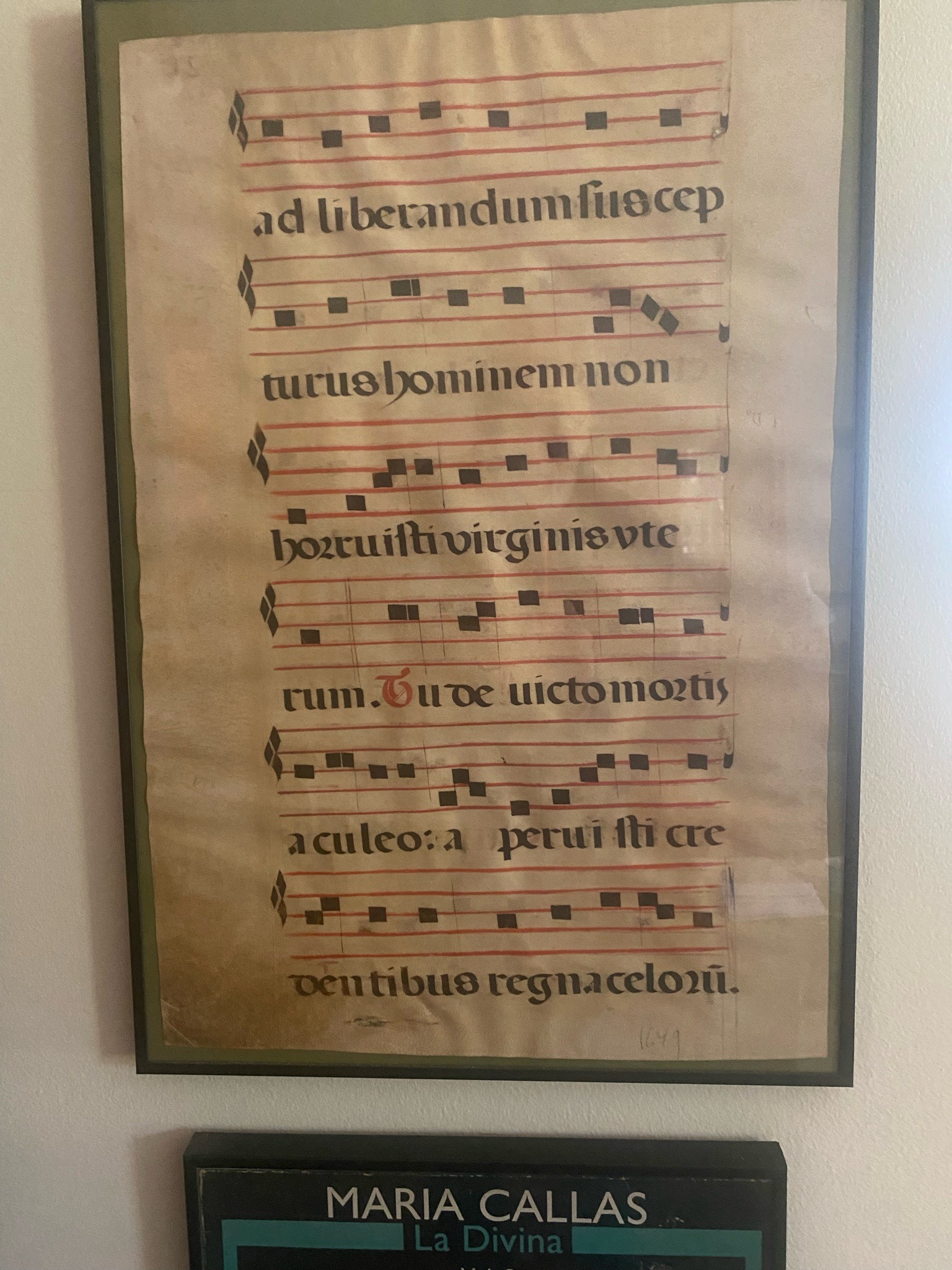
Framed Illuminated Gregorian Chant Manuscript Leaf on Vellum
This is a single illuminated manuscript leaf, likely from a large choir book such as an Antiphonary or Gradual. The piece is hand-rendered on vellum (parchment), evidenced by the organic texture and slight rippling of the substrate. It features square note musical notation (neumes) set on four-line staves ruled in red ink. The text below the music is written in a late Gothic liturgical hand (textura), appearing in black ink with a notable red rubricated initial letter. The Latin text appears to be part of the 'Te Deum' hymn, including phrases like 'ad liberandum suscepturus hominem non horruisti virginis uterum.' The leaf shows signs of age-related wear, including significant yellowing and browning of the vellum, particularly along the edges, and minor staining consistent with historical handling. There is a pencil or light ink date of '1649' visible in the lower right corner, which may suggest a 17th-century origin, though the style reflects traditions from the late 15th to 16th centuries. The manuscript is presented in a modern dark-toned frame with protective glass, preserving the original irregular edges of the parchment.
AI-Generated Appraisal Disclaimer
Estimated Value
$450 - $650
Basic Information
Category
Antiquarian Books and Manuscripts
Appraised On
May 5, 2026
Estimated Value
$450 - $650
Item Description
This is a single illuminated manuscript leaf, likely from a large choir book such as an Antiphonary or Gradual. The piece is hand-rendered on vellum (parchment), evidenced by the organic texture and slight rippling of the substrate. It features square note musical notation (neumes) set on four-line staves ruled in red ink. The text below the music is written in a late Gothic liturgical hand (textura), appearing in black ink with a notable red rubricated initial letter. The Latin text appears to be part of the 'Te Deum' hymn, including phrases like 'ad liberandum suscepturus hominem non horruisti virginis uterum.' The leaf shows signs of age-related wear, including significant yellowing and browning of the vellum, particularly along the edges, and minor staining consistent with historical handling. There is a pencil or light ink date of '1649' visible in the lower right corner, which may suggest a 17th-century origin, though the style reflects traditions from the late 15th to 16th centuries. The manuscript is presented in a modern dark-toned frame with protective glass, preserving the original irregular edges of the parchment.
Related Tags
Explore similar items and categories:
Get Your Items Appraised
Instant estimates of your treasures with AI-powered instant appraisals