AI Appraisal Estimate

AI-generated estimates · not official valuations

From the user

What was submitted

Photo and notes provided by the user — not generated by AI

Submitted item photo
Submitted photo · June 22, 2026

User's notes

Unknown artist, original untitled artwork

AI analysis below

AI appraisal

AI analysis & estimate

AI-Generated · Verify before acting

Everything below is generated by AI for informational purposes only. AI can make mistakes — the AI may misidentify items or misattribute them (artist, maker, brand, designer, origin, era). This is not an official valuation and should not be used for insurance, sale, tax, estate, legal, or lending purposes — or any decision requiring a certified appraisal. It is not an authoritative claim about any person, brand, or rights holder — do not share or rely on it as a factual statement about a third party. Always consult qualified professionals before making financial decisions.

Note

This analysis also relies on unverified notes provided by the user, which may be incomplete or inaccurate and could affect the result.

Read the full disclaimer

AI Identification

·Not independently authenticated·Verify before acting

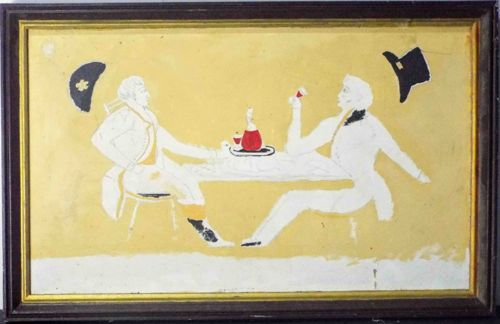
Folk Art Reverse Painting on Glass of Two Gentlemen Toasting

Fine Art - Folk Art / Reverse Glass Painting

AI Estimated Value

·Not an official valuation·Verify before acting

$400 - $600

As of June 22, 2026

AI Item Analysis

·AI can make mistakes·Verify before acting
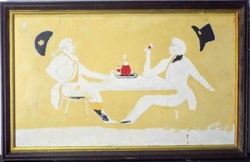
This is an original, untitled folk art work executed as a reverse painting on glass. The composition features two gentlemen in Regency-era attire seated at a table, engaged in a toast. The figures are rendered in a charmingly naive, flat style, utilizing a limited color palette of white, black, red, and ochre against a mustard-yellow background. The gentlemen wear white tailcoats and breeches, with one figure displaying dark boots. Above each figure floats a black hat—one a tricorn with a gold cockade and the other a top hat—adding a whimsical, surreal quality to the piece. Specifically, the central table holds a red decanter and glasses on a black tray. The work is housed in a dark wood frame with a gilded inner liner. Physically, the piece shows age-related wear, including significant flaking and loss of the white pigment in the lower foreground and throughout the figures' clothing, as well as Foxing and discoloration of the background. The style suggests an early 19th-century influence, likely mid-to-late 19th century in execution. The lack of a signature points to an itinerant or self-taught artist, a common characteristic of authentic American or European folk art from this period. The craftsmanship is simple but evocative, capturing a social scene with a distinct, primitive aesthetic.
AI Appraisal Report

·AI can make mistakes·Verify before acting
This work is a charming example of primitive or naïve folk art, specifically executed as a reverse painting on glass (verre églomisé). Based on the Regency-style attire and the distinct application style, it likely dates to the mid-to-late 19th century, possibly of American or English provincial origin. The whimsical element of the 'floating' hats is particularly engaging and characteristic of untrained itinerant artists of the period. However, the condition is the significant limiting factor here. There is substantial pigment instability, evidenced by heavy flaking and loss of the white paint in the foreground and on the figures' coats, revealing the underlayer. The background also exhibits discoloration consistent with age. While the 'naive' aesthetic is highly collectible, the market penalizes fragility in glass paintings because restoration is exceptionally difficult and expensive. Comparables for unsigned, decorative reverse glass paintings of social scenes generally fetch between $600 and $1,200 in good condition; due to the extensive paint loss here, I must adjust the valuation downward. Furthermore, authenticity verification from images alone is limited. A physical inspection would be required to examine the frame construction (to determine if it is original to the piece), assess the chemical composition of the glass (determining age via waviness or bubbles), and confirm that the paint loss has stabilized. Without provenance connecting this to a known folk artist or region, it is valued primarily as a decorative antique object.

Get your items appraised

Instant estimates of your treasures with AI-powered appraisals

Browse More Appraisals