AI Appraisal Estimate

AI-generated estimates · not official valuations

From the user

What was submitted

Photo and notes provided by the user — not generated by AI

Submitted item photo
Submitted photo · June 22, 2026

User's notes

Unknown Artist, Untitled original artwork

AI analysis below

AI appraisal

AI analysis & estimate

AI-Generated · Verify before acting

Everything below is generated by AI for informational purposes only. AI can make mistakes — the AI may misidentify items or misattribute them (artist, maker, brand, designer, origin, era). This is not an official valuation and should not be used for insurance, sale, tax, estate, legal, or lending purposes — or any decision requiring a certified appraisal. It is not an authoritative claim about any person, brand, or rights holder — do not share or rely on it as a factual statement about a third party. Always consult qualified professionals before making financial decisions.

Note

This analysis also relies on unverified notes provided by the user, which may be incomplete or inaccurate and could affect the result.

Read the full disclaimer

AI Identification

·Not independently authenticated·Verify before acting

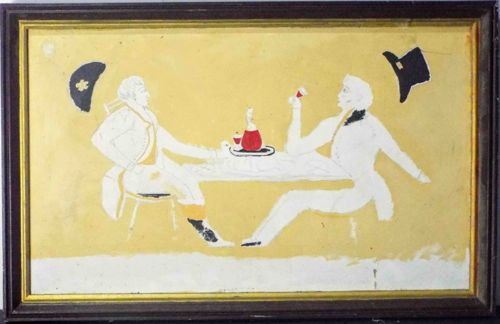
Folk Art Reverse Painting on Glass of Two Gentlemen Toasting

Fine Art / Folk Art

AI Estimated Value

·Not an official valuation·Verify before acting

$150 - $300

As of June 22, 2026

AI Item Analysis

·AI can make mistakes·Verify before acting
This is a horizontal, rectangular folk art piece, appearing to be a reverse painting on glass or a similar stencil-work on a flat panel. The artwork depicts two gentlemen in Regency-style attire, including tailcoats and cravats, seated at a dining table and engaged in a toast. The figures and the foreground are rendered in a stark off-white or cream pigment against a mustard-yellow or aged tan background. Splashes of color are used sparingly for detail, specifically red for the liquid in the glasses and a decanter, and black for the gentlemen's hats—a bicorne on the left and a top hat on the right—which appear to be floating or hanging in the background. The style is naive and characteristic of late 18th to mid-19th-century folk art, prioritizing silhouettes and flat planes of color over three-dimensional perspective. The piece is housed in a dark wooden frame with a narrow gilded inner lip. Condition-wise, the work shows signs of age consistent with a 19th-century origin; there is noticeable paint loss, flaking, and discoloration, particularly along the bottom edge and within the figure on the left. Several small dark spots (foxing or surface grime) are visible across the yellow background field. The frame exhibits minor scuffing and loss of gilding on the inner sight line, adding to the antique character of the object.
AI Appraisal Report

·AI can make mistakes·Verify before acting
This charming, albeit distressed, piece appears to be a reverse painting on glass or a stencil-work on a panel, likely dating from the mid-to-late 19th century based on the naive style and costume silhouettes. The subject—two gentlemen in Regency-style attire sharing a toast—is a classic motif in folk art, often intended for taverns or domestic dining spaces. The stark cream figures against the mustard-yellow background demonstrate a bold graphic quality typical of untrained or provincial artisans. Upon visual examination, the condition is the significant limiting factor for value. There is substantial paint instability, evidenced by noticeable flaking and loss, particularly on the lower left and within the central figures. The presence of dark spotting implies probable mold or foxing beneath the glass or on the backing, which threatens the remaining pigment. While the frame appears to be period-correct with its original gilded slip, it also shows age-related wear. The market for anonymous 19th-century folk art remains steady for pieces with high visual impact, but usually requires excellent condition to command prices in the four figures. Comparable reverse glass paintings in this level of distress typically sell at auction in the low hundreds. The piece has decorative appeal, but collectors will discount heavily for the conservation issues. To provide a definitive authentication, I would need to physically examine the verso to determine if the substrate is indeed glass or panel and to assess the stability of the paint layer. Removing the backing would also confirm if there are any hidden inscriptions or dates. Without provenance or a signature, value is strictly decorative and historical.

Get your items appraised

Instant estimates of your treasures with AI-powered appraisals

Browse More Appraisals