AI Appraisal Estimate

AI-generated estimates · not official valuations

From the user

What was submitted

Photo and notes provided by the user — not generated by AI

Submitted item photo
Submitted photo · June 10, 2026

User's notes

Galle vase

AI analysis below

AI appraisal

AI analysis & estimate

AI-Generated · Verify before acting

Everything below is generated by AI for informational purposes only. AI can make mistakes — the AI may misidentify items or misattribute them (artist, maker, brand, designer, origin, era). This is not an official valuation and should not be used for insurance, sale, tax, estate, legal, or lending purposes — or any decision requiring a certified appraisal. It is not an authoritative claim about any person, brand, or rights holder — do not share or rely on it as a factual statement about a third party. Always consult qualified professionals before making financial decisions.

Note

This analysis also relies on unverified notes provided by the user, which may be incomplete or inaccurate and could affect the result.

Read the full disclaimer

AI Identification

·Not independently authenticated·Verify before acting

Émile Gallé Cameo Glass Wisteria Vase

Art Glass / Antiques

AI Estimated Value

·Not an official valuation·Verify before acting

$1,200 - $1,800 USD

As of June 10, 2026

AI Item Analysis

·AI can make mistakes·Verify before acting
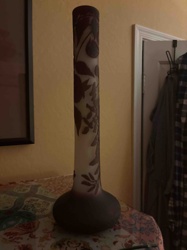
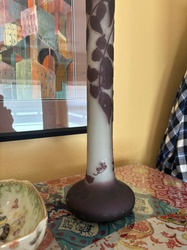
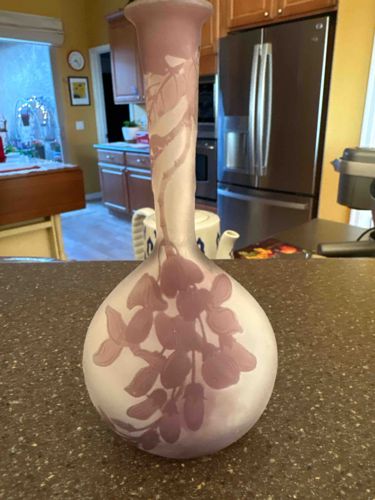
This is a tall, slender-necked cameo glass vase in the Art Nouveau style, attributed to the glassworks of Émile Gallé. The vessel features a bulbous, mallet-shaped base that transitions into a long, tapered neck with a slightly flared rim. It is constructed from multi-layered cased glass, utilizing an acid-etching technique to create the floral motif. The color palette consists of a frosted translucent white or light lavender ground with deep mauve or amethyst-colored overlays forming the 'Wisteria' pattern. The design showcases hanging clusters of floral blossoms and trailing leaves that wind gracefully up the neck of the vase. The cameo relief is relatively flat, characteristic of later production runs or industrial-led designs from the Gallé factory, likely dating between 1900 and 1920. Physically, the glass appears to be in good aesthetic condition without visible large chips or cracks, though slight surface scratches or shelf wear on the base are common for pieces of this age. The craftsmanship reflects the organic, nature-inspired aesthetics of the Nancy School in France, displaying a soft, matte finish on the background contrast with the detailed etching of the botanical elements. The overall height appears to be roughly 10 to 12 inches, though exact dimensions would require physical measurement.
AI Appraisal Report

·AI can make mistakes·Verify before acting
Based on my examination of the digital imagery and descriptive data, this cameo glass vase is a quintessential example of the 'Wisteria' pattern produced by the Émile Gallé factory in Nancy, France, likely dating between 1904 and 1920. The multi-layered acid-etched technique displays the characteristic depth and organic fluidness of the Art Nouveau movement. The amethyst-over-frosted-ground palette is a classic Gallé colorway that remains highly desirable among collectors. From my visual inspection, the glass appears to be in good condition; the crispness of the acid-etching suggests the piece has not suffered from significant over-polishing or 'sick glass' syndrome. The bulbous mallet shape is more stable and common than the elongated 'banjo' or 'stick' vases, which places it in a moderate price bracket for authentic Gallé cameo glass. Market demand for Galle remains steady, though prices for industrial-run pieces (those produced posthumously but within the factory's operation) have leveled out compared to the 1990s peak. This specific size (10-12 inches) is considered a 'cabinet piece' of ideal scale for modern displays. However, my assessment is limited by the inability to physically handle the item. A definitive authentication would require a tactile inspection to verify the signature (looking for signs of modern laser-etching versus authentic wheel-carved or acid-etched signatures) and a black light test to ensure no professional restorations have been made to the neck or rim. I would also seek provenance documentation to trace its ownership history. Without these steps, this valuation serves as a market estimate based on the assumption of authenticity and the absence of concealed fractures.

Get your items appraised

Instant estimates of your treasures with AI-powered appraisals

Browse More Appraisals