These notes were written by the person who submitted this item. Appraiser.AI has not verified them, and the AI's identification and estimate may rely on them.
AI Estimated Value
Not an official valuation
$300-500
AI estimate as of September 18, 2025 · verify with a professional before acting
AI-Generated · Verify before acting
Everything on this page is generated by AI for informational purposes only. AI can make mistakes — the AI may misidentify items or misattribute them (artist, maker, brand, designer, origin, era). This is not an official valuation and should not be used for insurance, sale, tax, estate, legal, or lending purposes — or any decision requiring a certified appraisal. It is not an authoritative claim about any person, brand, or rights holder — do not share or rely on it as a factual statement about a third party. Always consult qualified professionals before making financial decisions.
This analysis also relies on unverified notes provided by the user, which may be incomplete or inaccurate and could affect the result.
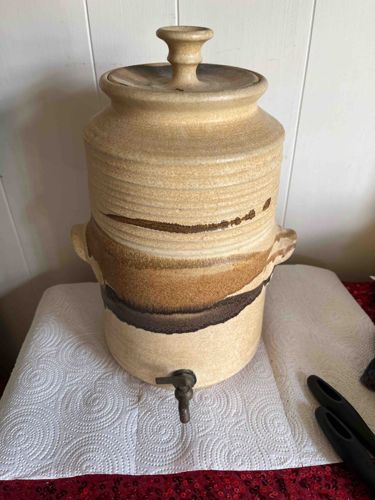
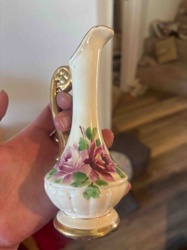
This is a hand-thrown studio pottery ceramic water dispenser, signed by 'Hartman.' The piece exhibits a cylindrical form with a slightly wider base and a narrower neck, topped with a matching ceramic lid featuring a knob-style finial. The overall color palette consists of natural, earthy tones, predominantly a light beige or sandy tan, with horizontal bands of a richer brown and dark brown/black glaze applied around the mid-section, creating an organic, wave-like or landscape effect. The ceramic body displays visible throwing rings, indicative of its handcrafted nature and adding to its tactile quality. Two small, ear-like handles are integrated into the body at the mid-section, positioned just below the decorative brown bands, suggesting ease of lifting or movement. A functional metal spigot, possibly brass or bronze given its dark, aged appearance, is fitted near the base of the dispenser. The dispenser appears to be in good overall condition, with no immediate visible chips, cracks, or significant damage from the provided images, though a closer inspection would be required to confirm this. The glaze has an unpolished, matte to semi-gloss finish, common in studio pottery. The style suggests a mid-20th century to contemporary period, likely post-1960s, reflecting a rustic or artisanal aesthetic. The craftsmanship appears to be of good quality, showcasing the potter's skill in both form and decorative glazing.
AI Appraisal Report
Based on my examination of the provided images and the description, this Studio Pottery Ceramic Water Dispenser, signed 'Hartman,' presents as a well-crafted piece. The cylindrical form, wider base, narrower neck, and knob-style finial lid showcase a skilled hand in throwing. The earthy, natural color palette of light beige/sandy tan, accented by brown and dark brown/black wave-like bands, reflects a rustic, artisanal aesthetic popular from the mid-20th century onwards. The visible throwing rings further confirm its handcrafted nature. The integrated ear-like handles and functional metal spigot (appearing to be aged brass or bronze) enhance its utility and design. From the images, the condition appears good, with no obvious chips, cracks, or significant damage. This visual assessment, however, is limited; an in-person inspection would be crucial to confirm the absence of hairline cracks, repairs, or internal damage, especially concerning the spigot's seal and the interior.
Market conditions for studio pottery vary greatly depending on the artist's renown. While 'Hartman' is a known name in studio pottery, specific market demand for this particular Hartman piece would likely fall into the general collectible studio ceramics category rather than a high-end investment piece without further artist attribution or exhibition history. Comparable studio pottery water dispensers or large vessels of similar quality and aesthetic typically fetch between $200-$600. The craftsmanship is commendable, suggesting good quality. The demand for functional and decorative pottery is steady, and this piece marries both aspects effectively.
Authenticity of the 'Hartman' signature cannot be definitively confirmed from images alone. A physical examination could help verify the signature's application (underglaze, incised, etc.) and comparison to known examples of Hartman's work would be necessary. Provenance documentation, such as original purchase receipts or exhibition history, would significantly bolster its authenticity and value. Without these, I am appraising it as a strong example of unnamed artist studio pottery, with the potential for increased value if positive authentication of the specific Hartman artist can be made.