AI estimate as of October 27, 2025 · verify with a professional before acting
AI-Generated · Verify before acting
Everything on this page is generated by AI for informational purposes only. AI can make mistakes — the AI may misidentify items or misattribute them (artist, maker, brand, designer, origin, era). This is not an official valuation and should not be used for insurance, sale, tax, estate, legal, or lending purposes — or any decision requiring a certified appraisal. It is not an authoritative claim about any person, brand, or rights holder — do not share or rely on it as a factual statement about a third party. Always consult qualified professionals before making financial decisions.
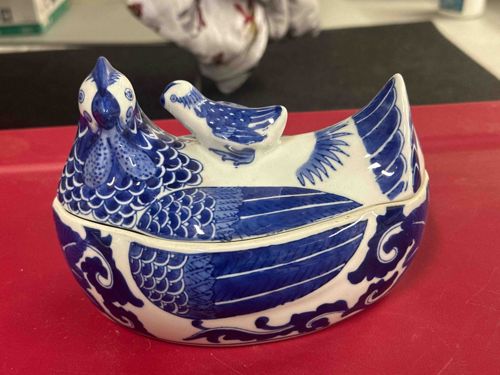
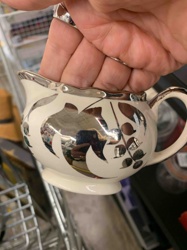
This item is a decorative ceramic hen on nest covered dish, often referred to as a tureen or butter dish, crafted in a classic blue and white underglaze style. The piece is formed in the shape of a seated hen, with the upper portion, including the head, neck, and back, serving as the lid, and the lower, nest-like body forming the base. The primary color scheme is white ceramic with intricate blue painted details. The hen's plumage is depicted with varying shades and patterns of blue, indicating feathers, with a scaly or feathered texture on its head and neck, and distinct wing markings on its back. A smaller chick figure is perched on the hen's back, also rendered in blue and white, enhancing the 'nest' theme. The base of the dish features a continuous pattern of blue scrolling motifs and what appears to be stylized wave or cloud designs, creating a dynamic visual border. The construction appears to be molded ceramic, with hand-painted details. The glaze has a glossy finish, typical of porcelain or fine earthenware. There are no immediately visible chips, cracks, or repairs, suggesting good overall condition. The painting exhibits a mix of fine lines and broader brushstrokes, particularly evident in the feathering and the decorative patterns on the base, indicating a level of craftsmanship. The distinct blue and white coloration and figural design suggest a possible Asian (e.g., Chinese or Japanese export porcelain influence) or Delftware style, common in decorative ceramics from the 19th to 20th centuries. Without a maker's mark, precise manufacturing details or age are difficult to ascertain, but the style is characteristic of traditional ceramic production.
AI Appraisal Report
I have examined the provided image of this blue and white ceramic hen on nest tureen/covered dish. Visually, the piece appears to be in very good condition, with no immediately discernible chips, cracks, or repairs. The glossy glaze is intact, and the hand-painted blue underglaze decoration, depicting the hen's plumage, a chick, and scrolling motifs on the base, is well-executed for a decorative ceramic of this type. The design suggests influence from traditional Asian export porcelain or Delftware, placing its likely origin somewhere between the late 19th to mid-20th century, though without a clear maker's mark or provenance, precise dating is speculative.
Market demand for decorative blue and white ceramic hen on nest dishes is generally steady, driven by collectors of figural ceramics and those seeking cottage-core or classic décor accents. While not rare, well-preserved examples with appealing hand-painted details tend to fetch higher prices. Comparable sales for similar vintage, unmarked figural covered dishes in good condition fall within the mid-range. Factors impacting value positively include its good condition, charming design, and the detailed painting. However, the lack of a known manufacturer or specific artist limits its potential as a high-value collectible.
Limitations for authenticity verification are significant. Without physical inspection, I cannot confirm the tactile quality of the ceramic, the uniformity of the glaze, or the precise nature of any minor imperfections that might be invisible in photographs. Furthermore, determining exact age and origin would greatly benefit from examining any potential maker's marks, assessing the ceramic body under magnification, and consulting provenance documentation. Scientific testing, such as thermoluminescence dating, could provide a more accurate age, but this is typically reserved for items of much higher potential value.