These notes were written by the person who submitted this item. Appraiser.AI has not verified them, and the AI's identification and estimate may rely on them.
AI Estimated Value
Not an official valuation
$350-550
AI estimate as of September 7, 2025 · verify with a professional before acting
AI-Generated · Verify before acting
Everything on this page is generated by AI for informational purposes only. AI can make mistakes — the AI may misidentify items or misattribute them (artist, maker, brand, designer, origin, era). This is not an official valuation and should not be used for insurance, sale, tax, estate, legal, or lending purposes — or any decision requiring a certified appraisal. It is not an authoritative claim about any person, brand, or rights holder — do not share or rely on it as a factual statement about a third party. Always consult qualified professionals before making financial decisions.
This analysis also relies on unverified notes provided by the user, which may be incomplete or inaccurate and could affect the result.
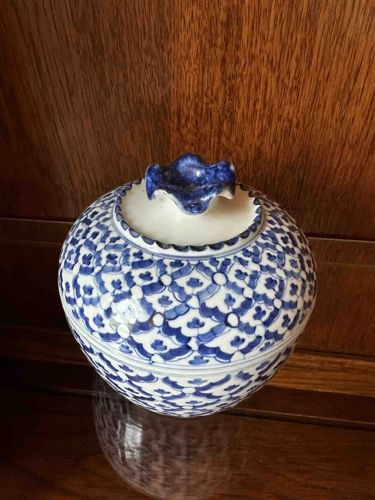
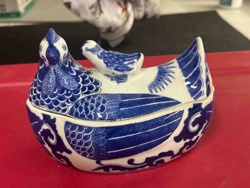
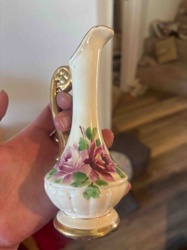
This is a spherical ceramic lidded jar, likely used as a covered bowl or storage vessel. It features a predominant blue and white color scheme, characteristic of porcelain and ceramic traditions, particularly those from Asia. The main body of the jar and its lid are adorned with an intricate, repeating pattern of blue floral or geometric motifs against a white background. This pattern appears to be meticulously hand-painted, showcasing fine lines and varying shades of cobalt blue, indicative of classical Benjarong ware or a similar blue and white ceramic style.
The jar's shape is globular, with a somewhat flattened top where the lid rests. The lid itself has a small, decorative finial or handle in the center, which is also blue and appears to be sculpted into a multi-lobed or wavy form, resembling a stylized flower or a shell. The rim of the lid is subtly curved inward, fitting snugly into the jar's opening. The glaze appears uniform and glossy, suggesting good craftsmanship and firing. There are no immediately visible chips, cracks, or significant repair marks from the provided image, indicating a relatively well-preserved condition. The quality of the brushwork and the complexity of the design suggest it could be a piece of traditional Thai ceramics, possibly Benjarong, known for its polychrome enamels, or a similar blue and white ware. The context of 'Asian, possibly Thailand' strongly supports this identification. It exhibits the detailed surface decoration and forms typical of such cultural artifacts. No specific maker's marks are discernible from the image.
AI Appraisal Report
Based on my visual examination of the provided image, this ceramic lidded jar presents as a charming example of blue and white ware, consistent with decorative ceramics from Southeast Asia, particularly Thailand. The intricate floral or geometric motifs, applied with apparent hand-painting and varying shades of cobalt blue against a white background, suggest decent craftsmanship. The globular shape and the stylized finial on the lid are characteristic of traditional Asian lidded vessels.
From the image, the condition appears to be very good; I observe a uniform, glossy glaze with no immediately visible chips, cracks, or significant repairs. This well-preserved state positively impacts its market value. While the description mentions Benjarong, this piece deviates from the polychrome enamels typically associated with true Benjarong ware, which is known for its five or more colors. This is a blue and white piece, often a separate category, though equally desirable.
Market conditions for decorative Asian ceramics, especially blue and white ware, remain steady. Pieces with good condition and appealing, intricate designs generally find buyers. Given its likely decorative rather than utilitarian purpose in the contemporary market, demand is moderate. While perhaps not exceptionally rare, good examples like this one always attract interest.
A significant factor impacting value is the lack of specific maker's marks or definitive provenance, which is common for such items. Without physical inspection, I cannot confirm the exact age, the precise technique used beyond visual observation, or the presence of any hairline cracks or restorations not visible in the image. To fully authenticate its origin and assess material quality, an in-person examination, potentially accompanied by provenance documentation or even scientific analysis of the clay and glaze, would be necessary.