These notes were written by the person who submitted this item. Appraiser.AI has not verified them, and the AI's identification and estimate may rely on them.
AI Estimated Value
Not an official valuation
$25-40
AI estimate as of July 30, 2025 · verify with a professional before acting
AI-Generated · Verify before acting
Everything on this page is generated by AI for informational purposes only. AI can make mistakes — the AI may misidentify items or misattribute them (artist, maker, brand, designer, origin, era). This is not an official valuation and should not be used for insurance, sale, tax, estate, legal, or lending purposes — or any decision requiring a certified appraisal. It is not an authoritative claim about any person, brand, or rights holder — do not share or rely on it as a factual statement about a third party. Always consult qualified professionals before making financial decisions.
This analysis also relies on unverified notes provided by the user, which may be incomplete or inaccurate and could affect the result.
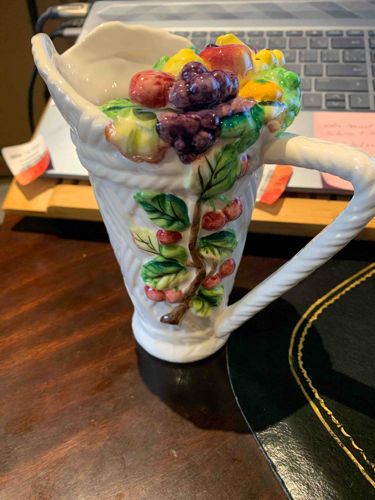
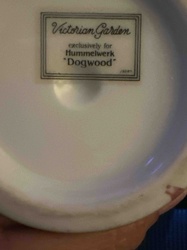
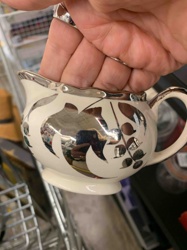
The item is a small, figural ceramic pitcher or creamer, likely made of porcelain or fine earthenware, characterized by an off-white or cream base color with vibrant hand-painted details. Its form is reminiscent of a woven basket, with molded relief textures simulating reeds or wicker, adding a tactile dimension. The top of the pitcher is adorned with a lavish arrangement of three-dimensional, painted fruits, including what appear to be purple grapes, red apples or cherries, green leaves, and possibly yellow or orange citrus fruits. This fruit cluster creates a highly decorative and somewhat opulent visual element. Below the fruit at the lip, on the body of the pitcher, there is further applied or sculpted relief work depicting a branch with green leaves and red berries (possibly cherries or currants), enhancing the naturalistic theme. The handle is distinctively designed in a twisted rope-like form, contributing to the rustic yet elegant aesthetic. The glazing appears to be glossy, particularly on the painted fruit and leaves, which have a notable sheen. There are no immediately visible chips, cracks, or significant losses to the ceramic body or the applied decorations, suggesting good overall condition for its presumed age. The colors of the fruits and leaves are bright and well-preserved. Based on the 'ESD Japan MR21206' context, this piece is likely a product of the mid-20th century, probably from the 1950s or 1960s, a period when Japanese ceramic manufacturers produced a large volume of decorative wares for export, often mimicking or drawing inspiration from European designs. The 'MR21206' could be a mold number or pattern number. The craftsmanship appears to be good, with attention to detail in the molding and painting of the fruit motifs, indicating a mass-produced but quality decorative item.
AI Appraisal Report
Upon examining the images and details provided for this ESD Japan Fruit Motif Ceramic Pitcher, I can assess its characteristics and market value. The piece presents as a well-preserved example of mid-20th century Japanese exportware, likely from the 1950s or 1960s. The 'ESD Japan' mark is consistent with manufacturers from this era who produced decorative ceramics for the Western market, and the 'MR21206' is likely a mold or pattern number. The condition appears to be very good, with vibrant colors and no visible chips or cracks from the photographs. The detailed, three-dimensional fruit motif and basket-weave texture are hallmarks of this decorative style, which often emulated more expensive European majolica.
The market for mid-century Japanese ceramics of this type is active but generally modest. Pieces by known manufacturers like ESD are collectible, but their value is often dictated by decorative appeal rather than extreme rarity. Comparable ceramic pitchers and creamers from ESD Japan with similar fruit motifs have recently sold in online marketplaces and at auction for prices in the $15 to $40 range, depending on condition and specific design. This piece's excellent apparent condition and intricate design place it at the higher end of that spectrum. Factors limiting a higher valuation include its mass-produced nature and a market that is currently saturated with similar decorative items.
It is important to note that this appraisal is based solely on digital images. A definitive authentication and condition assessment would require in-person examination to check for hairline cracks, restorations, or crazing under magnification. Without physical inspection, I cannot fully verify the absence of subtle damage that would impact its value.