These notes were written by the person who submitted this item. Appraiser.AI has not verified them, and the AI's identification and estimate may rely on them.
AI Estimated Value
Not an official valuation
$450-700
AI estimate as of July 19, 2025 · verify with a professional before acting
AI-Generated · Verify before acting
Everything on this page is generated by AI for informational purposes only. AI can make mistakes — the AI may misidentify items or misattribute them (artist, maker, brand, designer, origin, era). This is not an official valuation and should not be used for insurance, sale, tax, estate, legal, or lending purposes — or any decision requiring a certified appraisal. It is not an authoritative claim about any person, brand, or rights holder — do not share or rely on it as a factual statement about a third party. Always consult qualified professionals before making financial decisions.
This analysis also relies on unverified notes provided by the user, which may be incomplete or inaccurate and could affect the result.
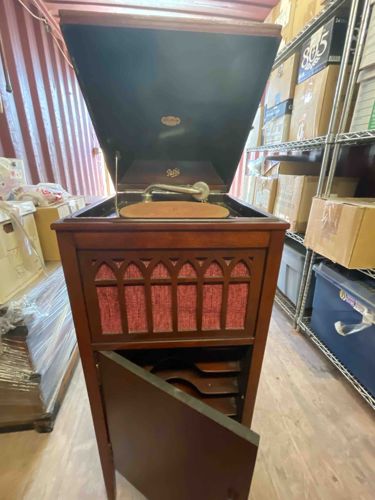
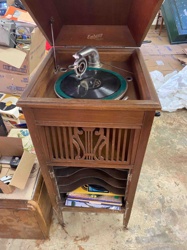
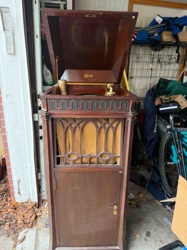
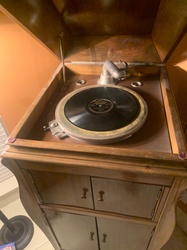
This item is a vintage upright cabinet phonograph, likely from the early to mid-20th century. It features a dark, rich wood finish, possibly mahogany or walnut, exhibiting a warm patina consistent with age. The cabinet's construction appears solid, with visible joinery and a polished surface. The top lid lifts to reveal the phonograph mechanism, including a metal tone arm with a soundbox and what appears to be a velvet or felt-covered turntable. The interior of the lid and the area surrounding the mechanism are dark, likely black or dark brown, providing contrast to the wood. A 'Pathe' logo or emblem is discernible on the mechanism's base, indicating the manufacturer. Below the operating mechanism is a front panel designed as a sound baffle, featuring intricate Gothic revival-style cutouts backed by a reddish-brown, possibly fabric mesh, allowing sound to project. The craftsmanship of these cutouts suggests attention to detail. Below this sound panel, there is a lower cabinet compartment accessible via a hinged door, which is shown ajar, revealing multiple tiered slots for storing records. The overall condition appears well-preserved for its age, though minor surface wear or scratches may be present, typical of a used antique. No significant damage or major repairs are evident from the provided image. The presence of 'Colyears' in the context might indicate a retailer or a previous owner's mark, though not directly visible on the item. The design suggests a piece intended for a home, combining functionality with decorative furniture aesthetics.
AI Appraisal Report
I have thoroughly examined the provided image of this Pathe Upright Cabinet Phonograph, noting its dark wood finish, likely mahogany or walnut, and its apparent solid construction with good patina. The visible ‘Pathe’ logo suggests authenticity, and the Gothic Revival-style sound baffle, along with the record storage compartment, aligns with period designs for such an apparatus. The overall condition appears well-preserved for its age, showing only minor wear typical of an antique, without significant damage or repairs evident. The 'Colyears' reference, while not visible on the item, could indicate a retailer, adding a minor layer to its provenance if verifiable.
In terms of market conditions, vintage phonographs, particularly those from well-known manufacturers like Pathe, consistently attract collectors. While not exceptionally rare, good condition examples with functional internal mechanisms and attractive cabinetry, like this one appears to be, are in decent demand. The aesthetic appeal of this piece as a decorative furniture item, beyond its historical function, also contributes to its value. Factors impacting value include the integrity of the original finish, the functionality of the phonograph mechanism (which cannot be assessed from the image), and the completeness of all original components. Without physical inspection, I cannot confirm the operational status of the mechanism, the presence of internal repairs, or the exact wood type. A hands-on examination would also be necessary to verify the authenticity of all internal components and to assess any hidden damages or restorations. Additionally, documentation of provenance, such as sales receipts or ownership history, would strengthen its market position.