These notes were written by the person who submitted this item. Appraiser.AI has not verified them, and the AI's identification and estimate may rely on them.
AI Estimated Value
Not an official valuation
$150-$300
AI estimate as of August 31, 2025 · verify with a professional before acting
AI-Generated · Verify before acting
Everything on this page is generated by AI for informational purposes only. AI can make mistakes — the AI may misidentify items or misattribute them (artist, maker, brand, designer, origin, era). This is not an official valuation and should not be used for insurance, sale, tax, estate, legal, or lending purposes — or any decision requiring a certified appraisal. It is not an authoritative claim about any person, brand, or rights holder — do not share or rely on it as a factual statement about a third party. Always consult qualified professionals before making financial decisions.
This analysis also relies on unverified notes provided by the user, which may be incomplete or inaccurate and could affect the result.
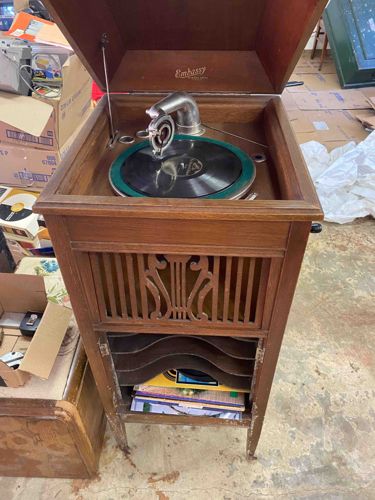
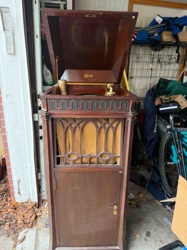
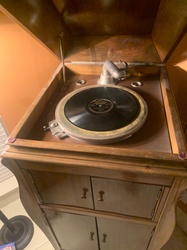
This appears to be an antique cabinet phonograph, commonly referred to as a record player, likely from the early to mid-20th century. The cabinet is constructed from wood, specifically light to medium-brown stained wood, possibly oak or a similar hardwood, showing visible grain. The overall form is a tall, upright cabinet with a hinged lid that opens to reveal the turntable and sound-reproducing mechanism. The top section features a metal tone arm with a needle assembly, poised over a black turntable with a distinctive green felt or material slipmat. The brand 'Embassy' is clearly visible on the inside of the lid, indicating the manufacturer. The front of the cabinet below the playing mechanism has a decorative gridded panel with an ornate, possibly carved or fretwork, design resembling a lyre or classical motif, which serves as the sound outlet. Below this, there are curved wooden dividers forming compartments, likely intended for storing records. The cabinet stands on four legs, which appear to be somewhat simplistic in design, possibly straight or subtly tapered.
Regarding condition, the wooden cabinet exhibits significant signs of wear consistent with its age. There are noticeable scuffs, scratches, and areas where the finish has worn off, particularly along the edges and on the legs, suggesting long-term use and transport. The patina is uneven, indicative of age and environmental exposure. While the internal components of the phonograph appear largely intact, their functional condition cannot be assessed from the image. The metal components, such as the tone arm, show some tarnishing but no obvious severe corrosion. The craftsmanship appears to be typical for mass-produced furniture of its era, combining functional design with some decorative elements.
AI Appraisal Report
Based on my visual examination of the provided image, this Embassy Cabinet Phonograph appears to be an authentic example of an early to mid-20th-century record player. The 'Embassy' branding is consistent with manufacturers from that era. The wooden cabinet, likely oak or a similar hardwood, exhibits significant wear including scuffs, scratches, and finish loss, particularly along edges and on the legs. This condition is typical for an item of its age and suggests considerable use and movement. The metal components show some tarnishing. While the internal mechanics appear intact, their functional condition cannot be assessed without an in-person inspection.
From a market perspective, cabinet phonographs generally have a niche but not exceptionally high demand. They are often sought by collectors interested in vintage audio equipment or those looking for decorative period pieces. However, their large size can be a limiting factor for modern homes. Items in a similar condition typically fetch modest prices. The 'Embassy' brand is not considered among the most rare or highly collectible compared to more premium manufacturers of the era. The decorative gridded panel and record storage compartments add some aesthetic appeal.
Factors significantly impacting value include the non-working condition (likely, as functionality cannot be confirmed), the extensive cosmetic wear to the cabinet, and the commonality of such phonographs. If the mechanism were fully functional and restored, the value would be higher. Conversely, the cost of professional restoration could exceed the item's potential market value. For full authentication and a definitive assessment of internal components, an in-person examination by a phonograph specialist, including testing for functionality and originality of parts, would be crucial. Provenance documentation, if available, could also add significant value.