These notes were written by the person who submitted this item. Appraiser.AI has not verified them, and the AI's identification and estimate may rely on them.
AI Estimated Value
Not an official valuation
$400-600
AI estimate as of July 19, 2025 · verify with a professional before acting
AI-Generated · Verify before acting
Everything on this page is generated by AI for informational purposes only. AI can make mistakes — the AI may misidentify items or misattribute them (artist, maker, brand, designer, origin, era). This is not an official valuation and should not be used for insurance, sale, tax, estate, legal, or lending purposes — or any decision requiring a certified appraisal. It is not an authoritative claim about any person, brand, or rights holder — do not share or rely on it as a factual statement about a third party. Always consult qualified professionals before making financial decisions.
This analysis also relies on unverified notes provided by the user, which may be incomplete or inaccurate and could affect the result.
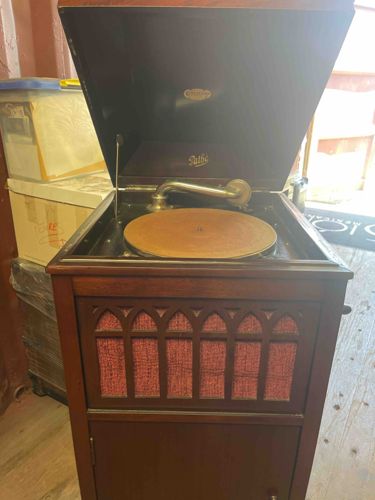
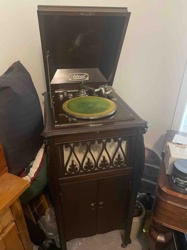
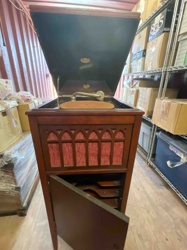
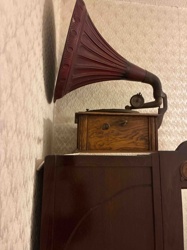
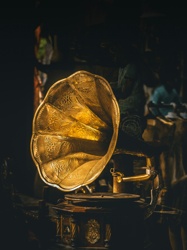
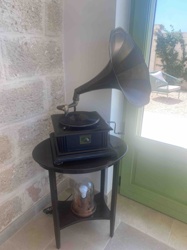
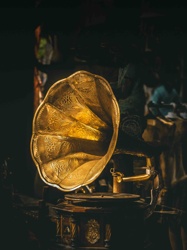
This item is identified as a Pathe Model 9253 console phonograph or gramophone, characterized by its upright cabinet design. The physical characteristics include a substantial wooden cabinet, likely mahogany or a similarly dark-stained hardwood, finished with a rich, deep brown hue. The top lid opens to reveal the turntable mechanism, which features a brown felt or velvet mat for records. A brass or gold-tone tone arm is visible, curving gracefully towards the center of the platter, indicative of an early sound reproduction system. The cabinet's front is adorned with a distinctive grille panel, featuring an intricate Gothic-arch-inspired fretwork design, behind which a reddish-orange fabric or mesh is visible, serving as a speaker grille. Below this decorative panel, the cabinet continues downwards, likely housing additional components or storage. Visible condition issues include what appears to be some dust accumulation on the turntable and general wear consistent with its age, though the overall external finish seems to be in relatively good condition with a visible sheen. There are no immediate signs of significant damage like cracks or major missing pieces in the wood, though a more thorough inspection would be required to identify subtle imperfections. The Pathe brand name is clearly visible on a small plate within the open lid, confirming its manufacturer. The aesthetic suggests a style period likely from the early to mid-20th century, possibly the 1920s to 1940s, aligning with the Art Deco or earlier traditional furniture styles for such domestic entertainment units. The craftsmanship, particularly the detailed fretwork, indicates a quality piece of furniture as well as a functional device.
AI Appraisal Report
I have carefully examined the provided image and details of this Pathe Model 9253 console phonograph. Based on this visual inspection, the piece appears to be in relatively good condition for its age. The wooden cabinet exhibits a rich, deep brown finish with a visible sheen, suggesting it has been reasonably well-preserved. There are no obvious signs of major structural damage, such as large cracks or missing pieces, which is a significant positive. I note some dust accumulation on the turntable, which is expected for an item of this vintage, and general wear consistent with its likely period of use (early to mid-20th century). The distinctive Gothic-arch-inspired fretwork grille and visible manufacturer's plate within the lid strongly support its authenticity as a Pathe Model 9253. \n\nRegarding market conditions, console phonographs from this era occupy a niche market. While general demand for such items isn't exceptionally high, there is consistent interest from collectors of antique audio equipment, Art Deco furniture, and those seeking unique decorative pieces for period-specific interiors. Rarity is moderate; while Pathe was a prominent manufacturer, this specific model isn't exceptionally rare, but neither is it commonplace. Factors positively impacting value include the seemingly good external condition, the completeness of the decorative fretwork, and the clear manufacturer identification. The primary limitation to definitive authenticity and condition assessment is the reliance on images alone. An in-person examination would be crucial to verify the operational status of the internal mechanisms (motor, tone arm movement, sound reproduction), assess any hidden damage or repairs to the cabinet, and confirm the condition of internal components, which significantly impact functional value. Provenance documentation (e.g., original sales receipts, ownership history) would further enhance confidence in authenticity and add historical value. Without physical inspection, I cannot confirm if the unit is in working order, a critical factor for many collectors.