AI estimate as of September 18, 2025 · verify with a professional before acting
AI-Generated · Verify before acting
Everything on this page is generated by AI for informational purposes only. AI can make mistakes — the AI may misidentify items or misattribute them (artist, maker, brand, designer, origin, era). This is not an official valuation and should not be used for insurance, sale, tax, estate, legal, or lending purposes — or any decision requiring a certified appraisal. It is not an authoritative claim about any person, brand, or rights holder — do not share or rely on it as a factual statement about a third party. Always consult qualified professionals before making financial decisions.
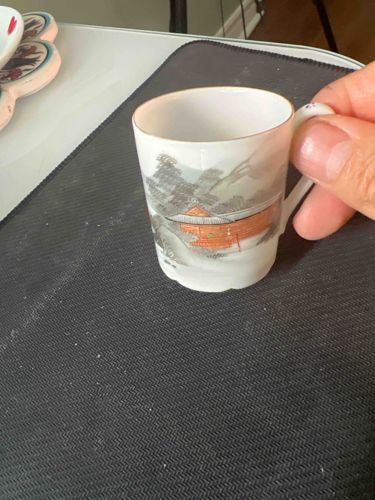
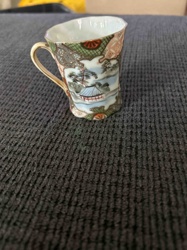
This is a miniature porcelain demitasse cup, likely Japanese in origin, featuring a hand-painted scenic design. The cup is slender and cylindrical, with a delicate C-shaped handle attached to one side. The primary colors of the decoration include subtle grays, greens, and a prominent reddish-orange hue, all against a white porcelain background. The imagery depicts a traditional East Asian landscape, possibly a mountain scene with trees and what appears to be a distinctive architectural structure, perhaps a temple or traditional house, rendered in the reddish-orange pigment. There is a thin gold trim along the rim of the cup, indicating a touch of elegance and possibly a higher quality of craftsmanship. The porcelain itself appears to be fine and translucent, common in Japanese export ware. The handle, though small, seems well-integrated into the cup's form. The overall condition appears good, with no immediately visible chips, cracks, or significant wear to the painted surface, although closer inspection would be needed to confirm this. The style suggests it could be from the early to mid-20th century, possibly Meiji or early Showa period, known for producing such export ceramics with detailed landscape motifs. The small size indicates it was intended for drinking espresso or a similar concentrated beverage. The artistry is delicate, showcasing fine brushwork typical of hand-painted porcelain. No visible maker's marks are discernible from the provided image.
AI Appraisal Report
This miniature porcelain demitasse cup, likely Japanese, presents with a finely hand-painted scenic design, featuring subtle grays, greens, and a distinct reddish-orange against a white porcelain body. The imagery, depicting a traditional East Asian mountain landscape with trees and a prominent architectural structure, suggests a Meiji or early Showa period origin, aligning with Japanese export ware. The delicate C-shaped handle and thin gold trim along the rim add a touch of elegance. Visually, the condition appears good; I see no immediate chips, cracks, or significant paint loss. The porcelain's perceived translucency points to a finer quality. However, without physical examination, I cannot definitively confirm its structural integrity or the extent of any hidden wear.
Market conditions for such Japanese scenic demitasse cups, while stable, are not indicative of high rarity unless attributed to a specific renowned kiln or artist, or if part of a complete, pristine set. Comparables for similar single, unsigned Japanese export demitasse cups typically range from $50 to $150, depending on the artistry and condition. The lack of discernible maker's marks limits its potential for higher valuation.
My assessment of authenticity is based solely on visual characteristics; the style is consistent with known Japanese export ceramics from the early to mid-20th century. For full authentication and a more precise valuation, an in-person examination would be critical to check for crazing, hairline fissures, repairs, and to assess the quality of the gold trim and porcelain body more accurately. Examination under UV light for repairs and the presence of any faint, obscured maker's marks would be necessary. Provenance documentation, such as original purchase records, would also significantly enhance authenticity verification, which is impossible from images alone.