AI estimate as of July 8, 2025 · verify with a professional before acting
AI-Generated · Verify before acting
Everything on this page is generated by AI for informational purposes only. AI can make mistakes — the AI may misidentify items or misattribute them (artist, maker, brand, designer, origin, era). This is not an official valuation and should not be used for insurance, sale, tax, estate, legal, or lending purposes — or any decision requiring a certified appraisal. It is not an authoritative claim about any person, brand, or rights holder — do not share or rely on it as a factual statement about a third party. Always consult qualified professionals before making financial decisions.
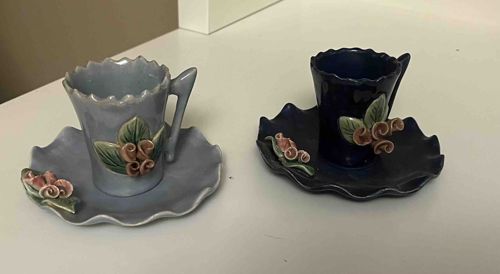
This set consists of two demitasse cups and matching saucers, likely intended for espresso or Turkish coffee, crafted from glazed ceramic. Each cup and saucer unit features a unique color scheme: one is a light powdery blue/lavender, and the other is a deep navy blue. The cups are small, cylindrical with a slight taper, and have a distinctive scalloped or wavy rim. The handles are an angular, elongated 'D' shape, contributing to their art deco-inspired aesthetic. The saucers are also irregularly shaped, with a wavy, organic edge that complements the cups' rims. Both cups and saucers are adorned with applied ceramic floral details. On the cups, there are three stylized, rolled-petal flowers, possibly roses or similar blooms, in a muted pink/brown hue, accompanied by two green leaves. A similar floral cluster featuring two flowers and leaves is affixed to one side of each saucer. The glaze appears consistent, with a glossy finish. There are no immediately visible chips, cracks, or significant wear, suggesting good preservation. The construction seems to be slip-cast or molded ceramic, with the decorative elements individually applied by hand, indicating a degree of craftsmanship. The overall design, with its soft colors, scalloped edges, and applied floral motifs, points towards a mid-20th century (possibly 1940s-1960s) aesthetic, reminiscent of Italian or European decorative ceramics from that period. There are no discernible maker's marks or signatures visible in the provided images, which would limit precise manufacturing details, but the consistent quality of the applied elements and the overall presentation suggest careful production.
AI Appraisal Report
I have carefully examined the provided image of this pair of ceramic demitasse cups and saucers with applied floral decoration. Visually, the condition appears excellent, with no immediate chips, cracks, or significant wear visible on either the glossy glaze or the delicate applied elements. The consistency of the glaze and the thoughtful application of the ceramic flowers and leaves suggest good craftsmanship. The design, featuring scalloped edges, angular handles, and applied floral motifs, strongly indicates a mid-20th century aesthetic, likely 1940s-1960s, reminiscent of Italian or European decorative ceramics. The two distinct color schemes add to their charm.
While the visual condition is strong, the primary limitation for authentication and valuation from images alone is the absence of a maker's mark or signature. Without physical inspection for hidden marks, or provenance documentation, it's difficult to pinpoint the exact manufacturer or country of origin, which significantly impacts value. In-person examination would also confirm the integrity of the applied elements, detect any hairline cracks, or assess the consistency of the ceramic body. Chemical analysis of the glaze or clay could potentially assist in origin verification, but is generally cost-prohibitive for items in this value range.
In terms of market conditions, decorative ceramic demitasse sets, especially those with unique hand-applied details, consistently find a niche market. While not high-demand collectible art, their aesthetic appeal and functional charm make them desirable in vintage and antique home decor circles. However, the lack of a known prestigious maker limits their top-tier market value. Demand is moderate, driven by collectors of decorative ceramics, mid-century modern enthusiasts, or those seeking unique table art. Rarity is moderate; while the specific design might be unique, similar decorative ceramic demitasse sets exist.
The absence of a maker’s mark is the most significant factor impacting value, preventing it from reaching higher collectible prices that pieces from renowned studios or designers would command. The excellent condition and appealing aesthetic are positive drivers.