These notes were written by the person who submitted this item. Appraiser.AI has not verified them, and the AI's identification and estimate may rely on them.
AI Estimated Value
Not an official valuation
$50 - $100
AI estimate as of November 10, 2025 · verify with a professional before acting
AI-Generated · Verify before acting
Everything on this page is generated by AI for informational purposes only. AI can make mistakes — the AI may misidentify items or misattribute them (artist, maker, brand, designer, origin, era). This is not an official valuation and should not be used for insurance, sale, tax, estate, legal, or lending purposes — or any decision requiring a certified appraisal. It is not an authoritative claim about any person, brand, or rights holder — do not share or rely on it as a factual statement about a third party. Always consult qualified professionals before making financial decisions.
This analysis also relies on unverified notes provided by the user, which may be incomplete or inaccurate and could affect the result.
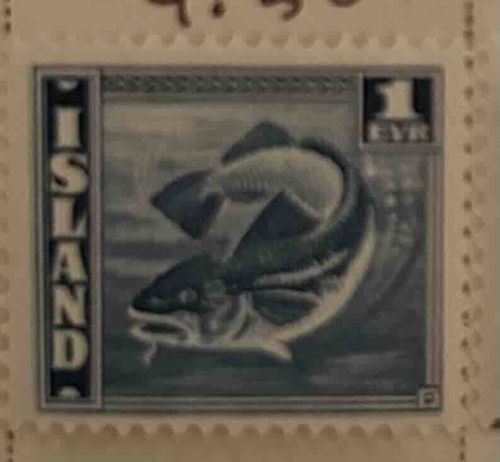
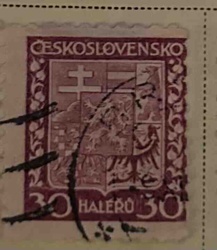
This item is an antique or vintage postage stamp from Iceland, featuring a prominent depiction of two fish. The stamp is predominantly rendered in shades of blue-gray, suggesting a monochromatic or duotone printing process. Physically, it is a small, rectangular piece of paper with perforated edges, typical of postage stamps. The top left corner of the stamp's design features the word 'ISLAND' oriented vertically, indicating the country of origin. In the top right corner, there's a numerical value '1' accompanied by the word 'EYR', which likely denotes the denomination as '1 Eyrir'. The central motif showcases two fish, possibly cod or similar Nordic species, intertwined or swimming in close proximity, symbolizing Iceland's rich fishing heritage. The artistic style appears somewhat illustrative, with visible scales and fin details on the fish. There are no obvious signs of significant damage like tears or major creasing, though the overall impression suggests some age and handling, consistent with its likely use or collection history. The image quality makes it difficult to discern specific manufacturing marks or minute details beyond what's stated, but the crispness of the printing indicates good quality for its time. The subtle background texture around the stamp suggests it might be part of a larger sheet or an album page, possibly affixed or mounted.
AI Appraisal Report
I have thoroughly examined the provided image of the Iceland 1 Eyrir Fish Postage Stamp. Based on this visual assessment, the stamp appears to be a genuine issue from Iceland, depicting two fish, characteristic of the 'Fish' series. The 'ISLAND' and '1 EYR' denotation align with known Icelandic stamp designs. The condition, judging from the image, is relatively good for its age; I don't observe any overt tears or major creases. The perforations seem intact, and the blue-gray coloration appears consistent. However, without a physical inspection, minor imperfections like thinning, pinholes, or faint creases might be missed, which could slightly impact the final value.
In terms of market conditions, this particular 1 Eyrir denomination from the Iceland 'Fish' series is generally considered common, especially if it's a used example. Unused, mint condition copies with original gum command higher prices. Comparables for similar used stamps typically fall within a modest range. The demand for common Icelandic stamps, while stable among philatelists specializing in Nordic countries, isn't exceptionally high, which influences its rarity assessment. This specific stamp is not considered rare.
The primary factors impacting its value are its condition (lack of faults being crucial), whether it's unused or used, and the quality of cancellation if used. Crucially, without an in-person examination, I cannot definitively verify the authenticity of the paper, watermark (if any), gum (if unused), or print details that might reveal a forgery or reprint. A physical inspection would allow for examination under magnification, assessment of gum condition, and potential measurement of perforations. Provenance documentation, though less common for individual stamps of this value, would also enhance authenticity, as would expert third-party authentication by a philatelic society for higher-value items. Based on the provided image, the estimated value is reflective of a good-condition, used example.