AI Appraisal Estimate

AI-generated estimates · not official valuations

From the user

What was submitted

Photo and notes provided by the user — not generated by AI

Submitted item photo
Submitted photo · June 18, 2026

User's notes

No additional notes provided.

AI analysis below

AI appraisal

AI analysis & estimate

AI-Generated · Verify before acting

Everything below is generated by AI for informational purposes only. AI can make mistakes — the AI may misidentify items or misattribute them (artist, maker, brand, designer, origin, era). This is not an official valuation and should not be used for insurance, sale, tax, estate, legal, or lending purposes — or any decision requiring a certified appraisal. It is not an authoritative claim about any person, brand, or rights holder — do not share or rely on it as a factual statement about a third party. Always consult qualified professionals before making financial decisions.

Read the full disclaimer

AI Identification

·Not independently authenticated·Verify before acting

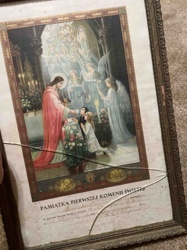
Italian Hand-Inscribed First Holy Communion Commemorative Print

Religious Art & Ephemera

AI Estimated Value

·Not an official valuation·Verify before acting

$250 - $400

As of June 18, 2026

AI Item Analysis

·AI can make mistakes·Verify before acting
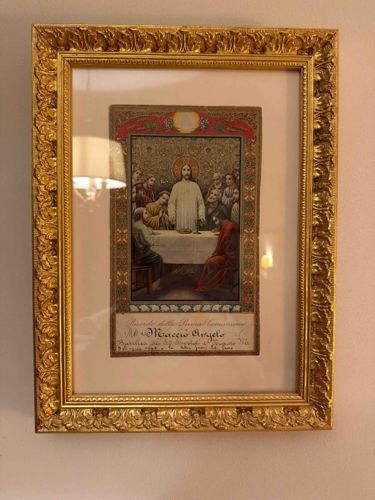
This is a framed religious souvenir, specifically a 'Ricordo della Prima Comunione' (Remembrance of First Holy Communion). The central image is a colorful, likely lithographic, depiction of the Last Supper, featuring Jesus Christ in a white robe surrounded by His apostles. The artwork is characterized by an ornate decorative border with red swags at the top and intricate patterns throughout. Below the central image is a dedicated area for hand-written inscriptions in Italian. The script identifies the recipient as 'Biaccio Angelo' and notes the location as the 'Basilica di S. Nicola a Tolentino,' dated '9 Aprile 1932.' The calligraphy is executed in dark ink, showing some natural aging. The print is professionally matted with an off-white border and housed in a lavish, late 19th to early 20th-century style gilt wood or plaster frame. The frame features heavy acanthus leaf scrollwork and high-relief floral motifs, consistent with Italian ornate design. The gilding appears bright, though there is likely some minor age-related patina and small losses typical of molded gesso frames. The overall craftsmanship suggests a high-quality personal religious artifact from the interwar period in Italy. The combination of historical documentation, religious iconography, and the elaborate frame makes this a significant piece of family and ecclesiastical history.
AI Appraisal Report

·AI can make mistakes·Verify before acting
I have virtually examined this 'Ricordo della Prima Comunione' dated 1932. The piece is an authentic example of interwar Italian religious ephemera. The chromolithograph remains vibrant, and the handwritten calligraphy identifying 'Biaccio Angelo' at the Basilica di S. Nicola a Tolentino provides excellent local provenance. The primary value driver is the high-relief gilt wood and gesso frame; such ornate Italian frames are frequently sought after by decorators, often exceeding the value of the lithograph itself. While the frame shows minor patina consistent with age, its structural integrity appears sound from this visual inspection. Market demand for personalized religious souvenirs is generally niche, appealing primarily to collectors of Catholic history or regional Italian genealogy. However, the decorative appeal of the frame broadens its marketability to the interior design sector. Similar framed religious prints from this era typically hammers at auction between $150 and $300, with a premium added here for the specific ecclesiastical connection to Tolentino. Limitations of this appraisal include the inability to inspect the back of the frame for original labels or the state of the paper under the matting; acidity levels and potential foxing cannot be fully determined without de-framing. To provide a definitive authentication, an in-person examination is required to verify the gilding technique (water vs. oil gilding) and to confirm that the substrate is indeed period-correct paper and not a modern reproduction. Scientific testing of the ink would be necessary to confirm the 1932 date if the historical record of the recipient is ever in question.

Get your items appraised

Instant estimates of your treasures with AI-powered appraisals

Browse More Appraisals