AI estimate as of August 29, 2025 · verify with a professional before acting
AI-Generated · Verify before acting
Everything on this page is generated by AI for informational purposes only. AI can make mistakes — the AI may misidentify items or misattribute them (artist, maker, brand, designer, origin, era). This is not an official valuation and should not be used for insurance, sale, tax, estate, legal, or lending purposes — or any decision requiring a certified appraisal. It is not an authoritative claim about any person, brand, or rights holder — do not share or rely on it as a factual statement about a third party. Always consult qualified professionals before making financial decisions.
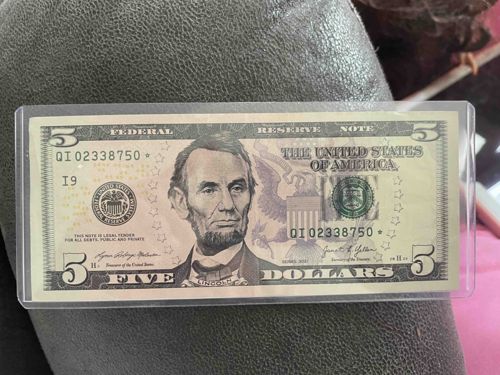
This item is a United States Five Dollar Federal Reserve Note, featuring a portrait of Abraham Lincoln on the obverse. The note appears to be in uncirculated or near-uncirculated condition, exhibiting crisp paper and vibrant inks with no visible folds, creases, tears, or smudges. It is currently encased in a clear plastic protective sleeve, which contributes to its pristine appearance. Key identifying features include the serial number "QI 02338750*" printed twice on the front, once in the lower right quadrant and again in the upper left quadrant. The asterisk at the end of the serial number indicates that this is a 'star note,' which is a replacement for a note that was imperfectly printed. This detail is significant to collectors. The Federal Reserve seal, a green circle with an eagle, is prominently displayed to the right of Lincoln's portrait. The Treasury seal, a black circle with a set of scales, is to the left. The denomination '5' is visible in all four corners, and 'FIVE DOLLARS' is printed along the bottom center. The note also displays the text 'THE UNITED STATES OF AMERICA' across the top center and 'THIS NOTE IS LEGAL TENDER FOR ALL DEBTS, PUBLIC AND PRIVATE'. Signatures of treasury officials are present below the portrait. The specific year of series, while not fully legible, is likely modern given the general appearance and the presence of the security features. The overall craftsmanship is high, typical of government-issued currency, suggesting precise printing and detailed engraving. The note's crispness and lack of wear indicate it has been well-preserved.
AI Appraisal Report
As an appraiser, I have carefully examined the image of this United States Five Dollar Federal Reserve Star Note. Visually, the note appears to be in uncirculated or near-uncirculated condition, exhibiting excellent crispness, vibrant inks, and a complete absence of folds, creases, tears, or smudges. The serial number QI 02338750* clearly identifies it as a star note, a significant feature for collectors as these are scarcer replacements for flawed prints.
Market conditions for modern five-dollar star notes are generally stable but do not command extremely high premiums unless they are part of a rare run or have a unique serial number (e.g., low serial, radar, or repeater). While the 'star note' status adds value, the specific serial number 02338750 does not immediately suggest ultra-rarity. The protective sleeve has clearly contributed to its pristine preservation, which is a major positive factor.
Demand for well-preserved modern currency, especially star notes, is consistent among collectors, but the rarity of this specific serial number series is key. Without precise information on the total print run of this specific series and district (indicated by the letter preceding the serial number, 'Q' in this case), it's challenging to pinpoint exact rarity. However, most modern star notes in superb condition typically trade in the range of $30 to $75, depending on the series and specific nuances of scarcity.
My assessment of authenticity is based purely on the visual cues in the image; the design, seals, and typography appear consistent with genuine Federal Reserve Notes. However, a definitive authenticity verification cannot be made from images alone. A full in-person examination would be required to verify paper quality, security features (such as watermarks, security threads, and color-shifting ink if applicable to this series), and printing nuances under magnification. Provenance documentation could further confirm its history and handling. Without physical inspection, I cannot rule out the possibility of a high-quality counterfeit or alteration, although the provided image suggests a genuine article in excellent state.