AI Appraisal Estimate

AI-generated estimates · not official valuations

From the user

What was submitted

Photo and notes provided by the user — not generated by AI

Submitted item photo
Submitted photo · May 16, 2026

User's notes

Paper money

AI analysis below

AI appraisal

AI analysis & estimate

AI-Generated · Verify before acting

Everything below is generated by AI for informational purposes only. AI can make mistakes — the AI may misidentify items or misattribute them (artist, maker, brand, designer, origin, era). This is not an official valuation and should not be used for insurance, sale, tax, estate, legal, or lending purposes — or any decision requiring a certified appraisal. It is not an authoritative claim about any person, brand, or rights holder — do not share or rely on it as a factual statement about a third party. Always consult qualified professionals before making financial decisions.

Note

This analysis also relies on unverified notes provided by the user, which may be incomplete or inaccurate and could affect the result.

Read the full disclaimer

AI Identification

·Not independently authenticated·Verify before acting

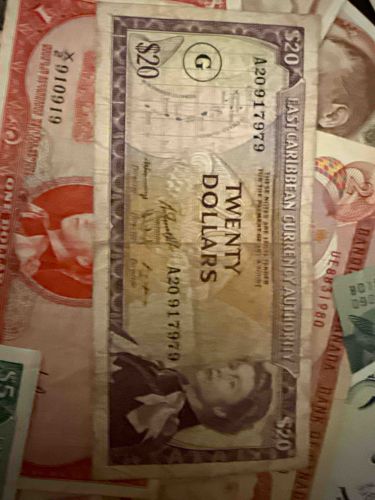
East Caribbean Currency Authority Twenty Dollars Banknote

Paper Money

AI Estimated Value

·Not an official valuation·Verify before acting

$35-50

As of May 16, 2026

AI Item Analysis

·AI can make mistakes·Verify before acting
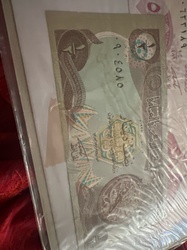
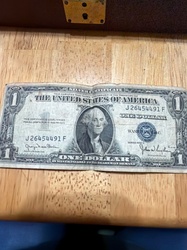
This item is an East Caribbean Currency Authority (ECCA) Twenty Dollars banknote, featuring a portrait of Queen Elizabeth II in her younger years. The note is vertically oriented, with 'TWENTY DOLLARS' printed prominently in green ink against a lighter background. The serial number 'A20917979' is visible twice on the front, once vertically on the left side and once horizontally below 'EAST CARIBBEAN CURRENCY AUTHORITY'. The denomination '$20' appears in several places, including the top left and bottom right corners, often with a letter 'G' within a circle adjacent to it, which likely indicates the issuing bank or a control mark. The phrase 'EAST CARIBBEAN CURRENCY AUTHORITY' is printed along the right edge of the note. Below this, there's a smaller text that begins 'THESE NOTES ARE...' and appears to state their legal tender status. The overall color scheme of the note is primarily purple and light green, with a detailed decorative border along the edges. The paper shows signs of circulation, including visible creases and folds, particularly down the center and across the body of the note, indicating moderate wear. There are no obvious tears or significant damage, but the colors appear slightly muted or faded in some areas, consistent with age and use. The craftsmanship appears to be standard for banknotes of its era, with intricate engraving and printing to prevent counterfeiting. Based on the portrait of the young Queen Elizabeth II and the issuer, it likely dates from the mid to late 20th century.
AI Appraisal Report

·AI can make mistakes·Verify before acting
I have examined the provided image of the East Caribbean Currency Authority Twenty Dollars banknote featuring Queen Elizabeth II. The note's condition, with visible creases, folds, and some muting of colors, indicates moderate circulation. While there are no apparent tears or major damage, the wear is consistent with a note that has seen regular use. The craftsmanship appears authentic for banknotes of this era, displaying intricate engraving and anti-counterfeiting measures. The serial number A20917979 is clearly visible. From a market perspective, East Caribbean Currency Authority notes featuring Queen Elizabeth II are generally collectible, but values are highly dependent on condition and specific series. This particular note, showing moderate wear, would place it in the Fine to Very Fine grade range. Comparables in similar condition typically trade in the $35-$50 USD range. Notes in uncirculated condition would command significantly higher prices, but this example does not fall into that category. While there is steady demand for Commonwealth banknotes, this specific denomination and series is not considered exceptionally rare in this circulated condition. It is important to state that this assessment is based solely on the provided image. A full authentication would require in-person examination to verify paper quality, watermarks, security threads, and other tactile elements that cannot be definitively assessed from a photograph. Additionally, under UV light, certain security features and potential repairs or alterations would become apparent. Provenance documentation, such as where and when it was acquired, could also add to its overall value and authenticity confirmation, though it is less critical for common circulated notes.

Get your items appraised

Instant estimates of your treasures with AI-powered appraisals

Browse More Appraisals