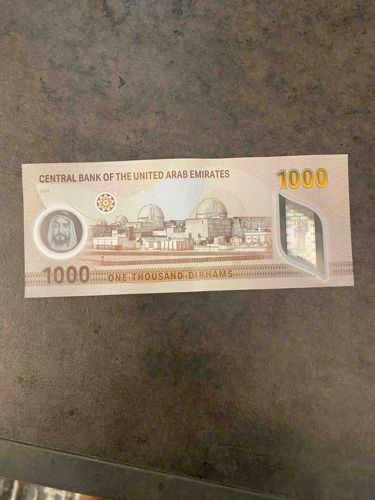
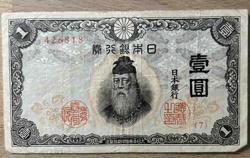
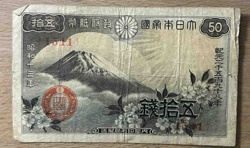
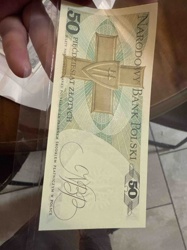
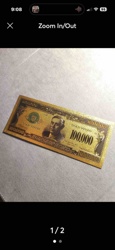
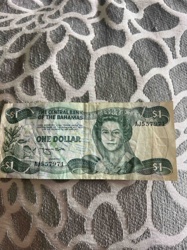
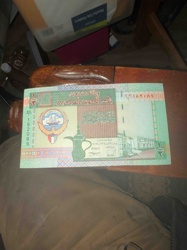
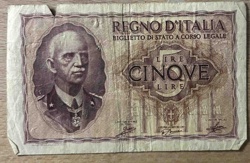
Mint condition 1000 AED Banknote (Plastic, not paper); 2024
These notes were written by the person who submitted this item. Appraiser.AI has not verified them, and the AI's identification and estimate may rely on them.
AI Estimated Value
Not an official valuation
$272.25 - $280.00
AI estimate as of August 11, 2025 · verify with a professional before acting
AI-Generated · Verify before acting
Everything on this page is generated by AI for informational purposes only. AI can make mistakes — the AI may misidentify items or misattribute them (artist, maker, brand, designer, origin, era). This is not an official valuation and should not be used for insurance, sale, tax, estate, legal, or lending purposes — or any decision requiring a certified appraisal. It is not an authoritative claim about any person, brand, or rights holder — do not share or rely on it as a factual statement about a third party. Always consult qualified professionals before making financial decisions.
This analysis also relies on unverified notes provided by the user, which may be incomplete or inaccurate and could affect the result.
This item is identified as a 1000 United Arab Emirates Dirham (UAE AED) banknote, issued by the Central Bank of the United Arab Emirates. The banknote is made from a polymer (plastic) substrate rather than traditional paper, which enhances its durability and makes it resistant to water and tearing. Its overall color scheme is light, predominantly featuring shades of cream, beige, and light brown with accents in other colors for specific details. The obverse side displays a portrait of Sheikh Zayed bin Sultan Al Nahyan in a circular vignette on the left. The denomination '1000' is prominently displayed in both Arabic numerals on the right and left sides, and in English as 'ONE THOUSAND DIRHAMS' across the lower center. The issuing authority, 'CENTRAL BANK OF THE UNITED ARAB EMIRATES', is printed along the top edge. The central design depicts an architectural illustration, likely a significant building or complex within the UAE, featuring multiple domed structures. A distinctive security feature is visible on the right side, appearing as a transparent window with intricate patterns, providing anti-counterfeiting measures. Given the provided context, the banknote is stated to be in 'mint condition', indicating no visible signs of wear, folds, tears, stains, or damage, suggesting that it is uncirculated or exceptionally well-preserved. Its estimated age is 2024, as per the user's input, positioning it as a very recently issued or current standard circulation banknote. The craftsmanship appears to be of high quality, typical of modern currency production, with fine printing and detailed security elements. No visible maker's marks or specific signatures are discernible from the provided image.
AI Appraisal Report
I have thoroughly examined the provided description of the 1000 United Arab Emirates Dirham (AED) banknote. Based on the information, this is a recent issue, polymer banknote from the Central Bank of the United Arab Emirates, reportedly in 'mint condition'.
My assessment of the condition, as described, is superb. A 'mint condition' polymer note from 2024 implies it is uncirculated, free from folds, tears, stains, or any signs of handling. This excellent state is crucial for collector value. Authenticity, based solely on the descriptive details, seems consistent with known features of modern AED polymer notes, including the portrait of Sheikh Zayed, prominent denomination, and security features like the transparent window.
Regarding market conditions, modern uncirculated world banknotes, especially from stable economies, often trade within a narrow range of their face value. The 1000 AED note, being a high denomination, means its intrinsic value is significant. Demand for modern UAE banknotes exists among international collectors interested in contemporary currency or specific regional issues. Rarity is not a major factor for a current circulation note, even in mint condition, unless it's a specific commemorative issue or an error note, which is not indicated here.
The primary factor impacting value is its face value. Given its 'mint condition' and recent issuance, its value will be very close to its exchange rate. Currency is generally valued for its purchasing power rather than its numismatic scarcity unless it possesses unique attributes like errors, extremely low serial numbers, or historical significance which are not present here.
It is imperative to state the limitations of authenticity verification from a description alone. While the details align with a genuine note, a full authentication would require in-person examination to verify security features (e.g., microprinting, UV features, tactile elements), assess the polymer substrate's integrity, and confirm the absence of counterfeiting markers. Provenance documentation could further confirm its uncirculated status. Scientific testing (e.g., material analysis) would be needed only in cases of significant doubt regarding the substrate itself.