AI estimate as of July 17, 2025 · verify with a professional before acting
AI-Generated · Verify before acting
Everything on this page is generated by AI for informational purposes only. AI can make mistakes — the AI may misidentify items or misattribute them (artist, maker, brand, designer, origin, era). This is not an official valuation and should not be used for insurance, sale, tax, estate, legal, or lending purposes — or any decision requiring a certified appraisal. It is not an authoritative claim about any person, brand, or rights holder — do not share or rely on it as a factual statement about a third party. Always consult qualified professionals before making financial decisions.
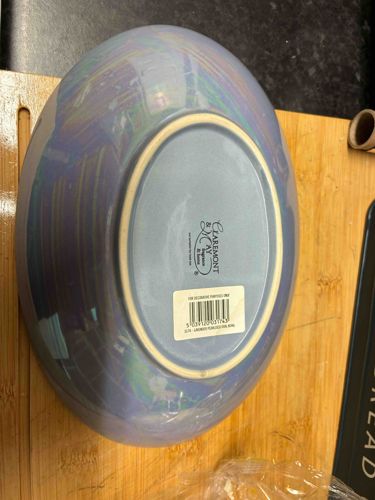
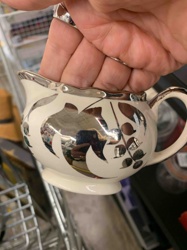
The item is an oval-shaped ceramic bowl, primarily colored in a vibrant, iridescent blue-purple hue that shimmers with various shades of blue, purple, green, and pink, resembling a mother-of-pearl or opalescent finish. This luminous effect is visible across its exterior, suggesting a specialized glaze application. The interior of the bowl is not visible, but the underside, which is also oval-shaped, features a matte, solid light blue color. A distinct, raised rim or foot in an off-white or cream color encircles the base, providing stability and a visual contrast to the iridescent body. This base rim appears to have some slight discoloration or remnants of adhesive from what might have been a previous label or packaging, but it is generally in good condition. The overall form is smooth and continuous, indicating a well-crafted ceramic piece. The item appears new or very lightly used, as it is still partially encased in clear plastic wrapping, which obscures a small portion of the bottom. There are no obvious chips, cracks, or significant wear visible. The craftsmanship seems to be of good quality, with an even application of the unique iridescent glaze. The manufacturing details are clearly visible on the underside: a label identifies the maker as 'Claremont & Bay'. Additionally, there's a barcode label with the text 'FOR DECORATIVE PURPOSES ONLY' and the product name 'ELITE - LAVENDER PEARLESQUE BOWL', along with a European Article Number (EAN) barcode (5 039120 011743). This explicit labeling suggests it is a relatively modern item, likely produced within the last few decades, and intended primarily for decorative rather than utilitarian purposes, such as serving food. The contemporary markings and apparent new condition indicate it belongs to a modern manufacturing period.
AI Appraisal Report
I have examined the image of the Claremont & Bay Elite Lavender Pearlesque Bowl. Visually, the bowl appears to be in excellent, near-new condition, indicated by the partial plastic wrapping and absence of visible damage like chips or cracks. The iridescent blue-purple glaze is consistently applied, highlighting good manufacturing quality. Authenticity, based on the clear 'Claremont & Bay' labeling and the EAN barcode (5 039120 011743), is readily established as a contemporary decorative item from this specific manufacturer. The 'FOR DECORATIVE PURPOSES ONLY' inscription confirms its intended use and limits its functional value.
Market conditions for modern decorative ceramic bowls of this nature are generally moderate. While the 'pearlescent' finish is aesthetically pleasing, it is not uncommon in contemporary mass-produced decor. Comparable items from similar brands typically retail in the lower to mid-range for home decor. Demand is modest, primarily from consumers seeking decorative accents rather than collectors of fine art pottery. Rarity is low, given its likely mass production as indicated by the standardized labeling and barcode. Factors impacting value include its new condition and contemporary aesthetic, which appeal to current decor trends. However, its declaration as 'decorative purposes only' and its modern, likely mass-produced origin prevent it from achieving significant value often seen in antique or artisan pottery.
It is crucial to note that this appraisal relies solely on visual examination of the provided image. While the condition appears excellent, a physical inspection would confirm the absence of any subtle hairline cracks, internal flaws, or hidden damage not visible externally. Full authentication of material composition (e.g., specific type of ceramic, glaze composition) would require scientific testing; however, for a modern decorative piece, the visible labeling provides sufficient authenticity context for appraisal purposes. Provenance documentation beyond the manufacturer label is not necessary given its contemporary nature and decorative intent.