AI Appraisal Estimate

AI-generated estimates · not official valuations

From the user

What was submitted

Photo and notes provided by the user — not generated by AI

Submitted item photo
Submitted photo · June 12, 2026

User's notes

No additional notes provided.

AI analysis below

AI appraisal

AI analysis & estimate

AI-Generated · Verify before acting

Everything below is generated by AI for informational purposes only. AI can make mistakes — the AI may misidentify items or misattribute them (artist, maker, brand, designer, origin, era). This is not an official valuation and should not be used for insurance, sale, tax, estate, legal, or lending purposes — or any decision requiring a certified appraisal. It is not an authoritative claim about any person, brand, or rights holder — do not share or rely on it as a factual statement about a third party. Always consult qualified professionals before making financial decisions.

Read the full disclaimer

AI Identification

·Not independently authenticated·Verify before acting

Vintage Multi-Drawer Apothecary Chest or Spice Cabinet

Antique Furniture / Primitive Collectibles

AI Estimated Value

·Not an official valuation·Verify before acting

$450 - $650

As of June 12, 2026

AI Item Analysis

·AI can make mistakes·Verify before acting
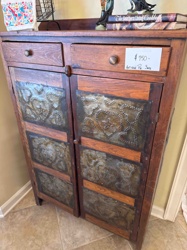
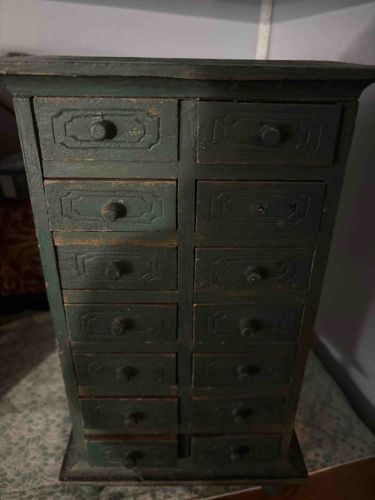
This is a rustic, vertical multi-drawer apothecary-style chest or spice cabinet, featuring fourteen individual drawers arranged in a seven-tier, two-column configuration. The piece is constructed from wood and finished in an aged, dark verdigris or 'colonial green' paint. Each drawer face is embellished with a carved or stamped rectangular frame design with notched corners, centered by a small, matching wooden turned knob. The overall structure follows a traditional primitive aesthetic, standing on a slightly flared base molding with small bun feet. The top features a simple overhang with a chamfered edge. In terms of condition, the piece exhibits significant age-related wear that contributes to its historical character. There is visible paint loss and abrasion along the drawer edges and the main frame, revealing the natural wood tone beneath, particularly on the left side of the middle drawers. The painted surface shows a heavy patina with fine crackling and possible surface dust or oxidation. There are no visible maker's marks or signatures, suggesting a handmade or small-shop production typically associated with late 19th-century to early 20th-century folk art or primitive furniture. Its vertical orientation and high drawer count suggest it was originally intended for storing small items such as medicinal herbs, spices, or sewing notions. The craftsmanship is functional and robust, characterized by simple joinery typical of the period.
AI Appraisal Report

·AI can make mistakes·Verify before acting
Upon visual examination of this fourteen-drawer apothecary chest, I find it to be a compelling example of American primitive utilitarian furniture. The vertical orientation and 'colonial green' verdigris finish are highly desirable in the current folk art market. The wear patterns appear consistent with authentic age; however, the uniform nature of the crackling on the paint surface requires careful scrutiny to rule out 20th-century 'distressed' reproductions. The construction, featuring fourteen drawers and traditional bun feet, suggests a late 19th-century origin, likely intended for domestic spice storage or a small-scale pharmacy. Market demand for primitive cabinetry remains stable, particularly for pieces with original-style surface pigments and high drawer counts. Comparables for similar-sized pine chests with non-original but aged painted surfaces typically fetch between $400 and $700 at regional auctions. The lack of visible joinery (such as dovetails) in the provided view limits a precise dating. Limitations: This appraisal is based solely on photographic evidence. A physical inspection is mandatory to confirm the wood species, analyze the nail construction (square vs. wire), and verify if the paint is a true milk paint or a modern chemical equivalent. Provenance documentation or an interior drawer inspection for handwritten notations would significantly enhance the valuation. I cannot definitively confirm authenticity without a tactile examination of the drawer runners for wear patterns consistent with century-long use.

Get your items appraised

Instant estimates of your treasures with AI-powered appraisals

Browse More Appraisals