AI Appraisal Estimate

AI-generated estimates · not official valuations

From the user

What was submitted

Photo and notes provided by the user — not generated by AI

Submitted item photo
Submitted photo · June 10, 2026

User's notes

Jelly cabinet

AI analysis below

AI appraisal

AI analysis & estimate

AI-Generated · Verify before acting

Everything below is generated by AI for informational purposes only. AI can make mistakes — the AI may misidentify items or misattribute them (artist, maker, brand, designer, origin, era). This is not an official valuation and should not be used for insurance, sale, tax, estate, legal, or lending purposes — or any decision requiring a certified appraisal. It is not an authoritative claim about any person, brand, or rights holder — do not share or rely on it as a factual statement about a third party. Always consult qualified professionals before making financial decisions.

Note

This analysis also relies on unverified notes provided by the user, which may be incomplete or inaccurate and could affect the result.

Read the full disclaimer

AI Identification

·Not independently authenticated·Verify before acting

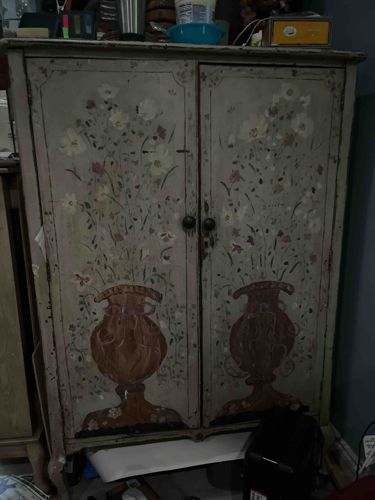
Hand-Painted Folk Art Jelly Cabinet

Antique Furniture / Folk Art

AI Estimated Value

·Not an official valuation·Verify before acting

$850 - $1,200

As of June 10, 2026

AI Item Analysis

·AI can make mistakes·Verify before acting
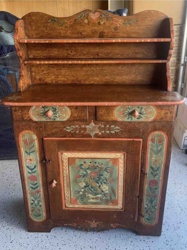
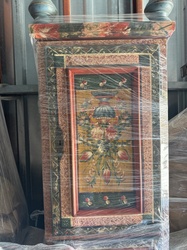
This is a vintage or antique jelly cabinet featuring symmetrical hand-painted floral motifs on its two doors. The piece is constructed primarily of wood, finished in a muted gray or light blue base coat that exhibits significant natural aging and distress. Each door contains a tall, folk-art style depiction of a terracotta-colored urn overflowing with a variety of wildflowers in shades of white, pink, and yellow. The painting style is characterized by thin, expressive linework and stylized floral heads. Physically, the cabinet features an overhanging top surface and sits on short, slightly curved cabriole-style legs with a scalloped bottom apron. Two small, dark round knobs facilitate opening the doors. The condition reflects heavy use and age, with visible paint loss, surface scratches, and grime buildup particularly along the top edge, corners, and base. There appears to be some minor structural chipping on the left side panel. The style suggests early 20th-century American farmhouse or European cottage furniture, likely dating from the 1920s to the 1940s. Its value is largely derived from the unique, hand-executed decorative folk art which covers the entire front facade, transforming a utilitarian storage piece into a decorative focal point.
AI Appraisal Report

·AI can make mistakes·Verify before acting
Based on my visual examination of this jelly cabinet, I have assessed it as an authentic piece of mid-to-early 20th-century folk art, likely originating between 1920 and 1945. The piece features a muted gray-blue ground that provides an excellent canvas for the symmetrical floral motifs. The hand-painted urns and expressive linework suggest a skilled, though likely unschooled, artist, which captures the 'naïve' aesthetic currently in high demand within the American farmhouse and European cottage markets. The condition is consistent with 'shabby chic' or 'primitive' interior trends; while there is significant paint loss, surface grime, and minor structural chipping, these elements contribute to its authentic patina rather than detracting from its value as a decorative focal point. Comparables for hand-painted utilitarian furniture of this era typically fall within the $700 to $1,500 range depending on the complexity of the artwork. The rarity of this piece lies in the survival of the original painting, which transforms a standard storage cabinet into a piece of art. However, visual inspection via image has limitations. I cannot definitively confirm wood species, joinery techniques (such as dovetailing or pegging), or the chemical composition of the pigments. A full authentication would require an in-person physical examination to check for structural repairs, any over-painting of the original motifs, and provenance documentation to pinpoint a specific regional origin. Scientific testing for lead content in the paint could also help verify the age of the original application.

Get your items appraised

Instant estimates of your treasures with AI-powered appraisals

Browse More Appraisals