AI estimate as of July 19, 2025 · verify with a professional before acting
AI-Generated · Verify before acting
Everything on this page is generated by AI for informational purposes only. AI can make mistakes — the AI may misidentify items or misattribute them (artist, maker, brand, designer, origin, era). This is not an official valuation and should not be used for insurance, sale, tax, estate, legal, or lending purposes — or any decision requiring a certified appraisal. It is not an authoritative claim about any person, brand, or rights holder — do not share or rely on it as a factual statement about a third party. Always consult qualified professionals before making financial decisions.
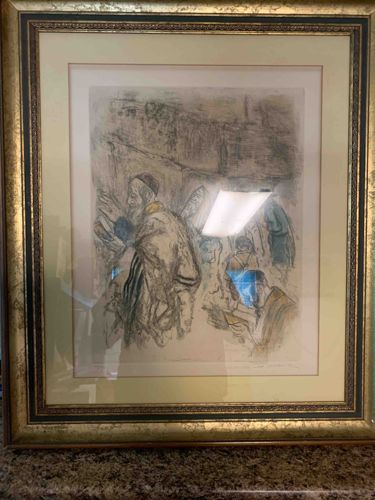
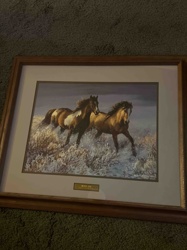
The item is a framed art print, likely a lithograph or etching, depicting a scene with multiple figures, possibly in a religious or communal setting. The dominant colors in the print are muted tones of grey, black, and beige, with subtle accents of blue and yellow-gold. The style appears expressionistic or abstract, with sketch-like lines and a somewhat somber mood. One prominent figure in the left half of the print wears a head covering and a patterned garment, seemingly engaged in an activity involving their hands, possibly praying or reading. Other figures are less distinct, rendered with loose, flowing lines. The print is housed under glass and is set within a multi-layered frame. The outer frame is gold-colored with a detailed, possibly carved or molded, ornamental pattern, giving it a classic and somewhat ornate appearance. Inside the outer frame, there is a dark green or black inner border, followed by a wide, lighter green or beige mat board that provides substantial spacing around the artwork. The corners of the outer frame exhibit minor scuffs or wear consistent with age and handling. The glass directly over the artwork shows significant glare from ambient lighting, indicating it is not non-glare glass and obscuring some details of the print, particularly in the center-right. No specific maker's marks or signatures are clearly visible from the provided images, making it difficult to ascertain the artist or manufacturing details. The overall condition appears good for a framed piece of its likely vintage, with no obvious major damage to the print itself, though the frame shows slight signs of use. The choice of framing suggests a desire to present the artwork formally, hinting at its perceived artistic or sentimental value. Based on the artistic style and framing, the piece could potentially date from the mid-20th century or later.
AI Appraisal Report
Based on my visual examination of the provided image, this framed figurative art print, likely a lithograph or etching, appears to be in good overall condition for its presumed vintage. The print itself shows no obvious major damage from this perspective, though the significant glare on the glass obscures some central details. The multi-layered frame, with its ornate gold outer section and inner mats, exhibits minor scuffs consistent with age and handling, but remains structurally sound. The stylistic elements—muted tones, loose lines, and expressionistic appeal—suggest a mid-to-late 20th-century origin. Without clear maker's marks or a signature, I cannot definitively authenticate the artist or specific printmaking technique; this is a significant limitation of image-based appraisal. The lack of provenance documentation also hinders full authentication. In terms of market conditions, figurative prints from lesser-known artists or without a strong exhibition history generally command moderate prices. Comparable works of similar style and condition from unidentified artists typically fall into this range. Demand for such pieces is steady but not exceptionally high unless an artist or series gains renewed interest. The visual lack of rarity, coupled with generic title (i.e. 'framed art print'), places this in the general art market. Factors significantly impacting value include the artist's identity (if a known artist), the print's edition size (if limited), and its historical significance. To fully authenticate and assess value, an in-person examination would be crucial to inspect the printmaking details, paper quality, and search for faint signatures or edition numbers not visible here. Scientific testing might be used to verify print medium or ink age, and provenance documentation would confirm the work's history. Given the current information, it is appraised based on its decorative and artistic merit rather than intrinsic rarity or known authorship.