These notes were written by the person who submitted this item. Appraiser.AI has not verified them, and the AI's identification and estimate may rely on them.
AI Estimated Value
Not an official valuation
$40-70
AI estimate as of November 28, 2025 · verify with a professional before acting
AI-Generated · Verify before acting
Everything on this page is generated by AI for informational purposes only. AI can make mistakes — the AI may misidentify items or misattribute them (artist, maker, brand, designer, origin, era). This is not an official valuation and should not be used for insurance, sale, tax, estate, legal, or lending purposes — or any decision requiring a certified appraisal. It is not an authoritative claim about any person, brand, or rights holder — do not share or rely on it as a factual statement about a third party. Always consult qualified professionals before making financial decisions.
This analysis also relies on unverified notes provided by the user, which may be incomplete or inaccurate and could affect the result.
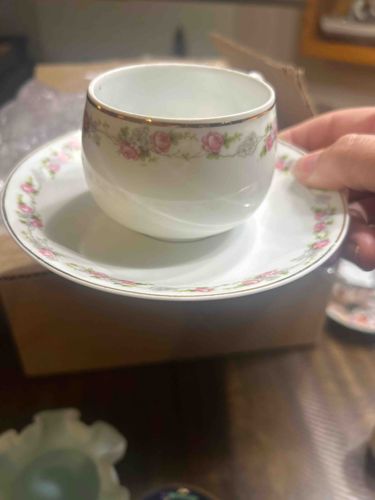
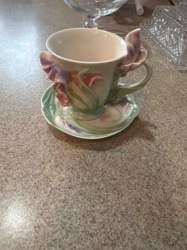
This appears to be a vintage German porcelain teacup and saucer set, characterized by its delicate aesthetic and floral decoration. The set features a white porcelain body, common for fine tableware, providing a clean canvas for the intricate design. Both the teacup and saucer are adorned with a continuous band of small, painted pink roses, interspersed with soft green foliage and delicate white or cream-colored scrollwork or lace-like patterns. This floral border runs along the rim of the saucer and around the upper portion of the teacup. A thin gold-colored trim accents the very rim of both the teacup and the saucer, adding a touch of elegance and highlighting the craftsmanship. The teacup itself is round and shallow, with a soft, rounded bottom transitioning into the walls. While the handle is not explicitly visible in the primary image, other similar German porcelain cups of this style often feature small, graceful handles. The saucer is a classic circular shape, designed to cradle the teacup. The overall condition appears to be good, with no immediately obvious cracks, chips, or significant wear to the gilding or painted decoration. The 'Made in Germany' context indicates its origin, suggesting it dates from a period when such porcelainware was highly esteemed, likely mid-20th century or earlier. The fine details in the hand-painted roses and the gold trim suggest a good quality of craftsmanship and materials.
AI Appraisal Report
Based on my visual examination of the provided image, this vintage German porcelain teacup and saucer set appears to be in good overall condition. I observe no obvious chips, cracks, or significant wear to the floral decoration or the gold trim, which is crucial for maintaining value in decorative porcelain. The 'Made in Germany' origin, as stated, confirms its provenance from a region historically renowned for quality porcelain production. The delicate hand-painted pink roses, green foliage, and scrollwork, coupled with the gold accent, indicate a good level of craftsmanship typical of mid-20th century or possibly earlier German porcelain.
In terms of market conditions, vintage teacup and saucer sets, especially those of good quality and condition from established European manufacturers, generally hold steady but modest value. Comparables for similar German porcelain floral-decorated sets in excellent condition typically range from $30 to $80. While charming, this specific design is not exceedingly rare nor does it appear to be from a highly sought-after manufacturer that commands premium prices (e.g., Meissen, KPM, etc., without specific maker's marks visible). The demand for such intricate decorative teasets remains consistent among collectors and enthusiasts of vintage tableware, but it is not experiencing a significant surge that would drive prices higher.
Factors impacting value positively include its apparently pristine condition and classic aesthetic. However, the lack of a visible specific maker's mark (e.g., Limoges, Rosenthal, Hutschenreuther, etc.) on the underside, which is not discernible from the image, prevents a more precise valuation. Higher brand recognition would typically lead to a higher appraisal. My assessment of authenticity and condition is limited to visual inspection of the image provided. For full authentication, an in-person examination would be required to thoroughly inspect for hairline cracks, chips, gilding wear, and to identify any maker's marks, which are paramount for definitive identification and valuation. Provenance documentation, if available, would also greatly assist in confirming authenticity and history.