AI estimate as of November 9, 2025 · verify with a professional before acting
AI-Generated · Verify before acting
Everything on this page is generated by AI for informational purposes only. AI can make mistakes — the AI may misidentify items or misattribute them (artist, maker, brand, designer, origin, era). This is not an official valuation and should not be used for insurance, sale, tax, estate, legal, or lending purposes — or any decision requiring a certified appraisal. It is not an authoritative claim about any person, brand, or rights holder — do not share or rely on it as a factual statement about a third party. Always consult qualified professionals before making financial decisions.
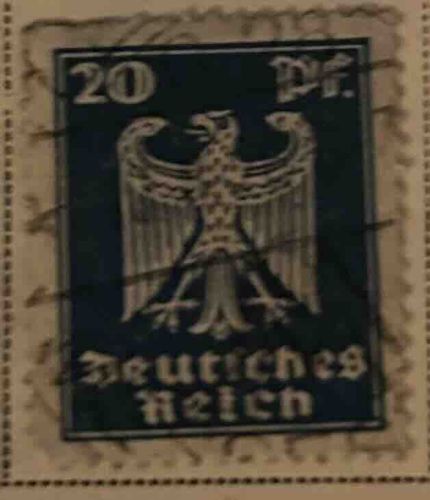
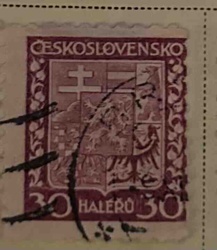
This item is a historical postage stamp from the German Empire, featuring a dark blue (likely deep indigo or possibly forest green) background with a cream-colored or light beige design. The central motif is a detailed depiction of the German imperial eagle, wings spread wide, stylized with linear feathering and sharp talons. Above the eagle, in the upper left corner, '20' is printed, indicating the denomination. To its right, 'Pf.' is discernible, presumably short for Pfennig, the currency unit. Below the eagle, the words 'Deutsches Reich' are printed in a gothic or Fraktur-style typeface. The stamp appears to be perforated along all four edges, indicating it was separated from a sheet of stamps. The edges show some wear and slight nicks, suggesting it may have been handled or removed from an album. There are several horizontal and diagonal black lines visible across the stamp, which are likely cancellations marks, signifying that the stamp has been used. The overall condition appears to be good for a used stamp of its age, with no significant tears or large creases visible, though the resolution limits a definitive assessment of paper quality or any potential repairs. Given the 'Deutsches Reich' inscription and the design, it likely dates from the late 19th or early 20th century, specifically the period of the German Empire. The craftsmanship appears to be typical of government-issued philatelic items from that era, with clear printing and accurate registration of the design.
AI Appraisal Report
I have examined the detailed image of this German Empire 20 Pfennig postage stamp. Visually, the stamp appears to be a legitimate issue from the 'Deutsches Reich' period, likely late 19th or early 20th century, given the design and inscription. The central imperial eagle motif, denomination '20 Pf.', and 'Deutsches Reich' in Fraktur script are consistent with known issues of the German Empire. It exhibits a dark blue background with a cream-colored design.
The condition, considering its age and cancellation marks, is good for a used stamp. The perforations are present on all four edges, although some wear and minor nicks are visible. The multiple black cancellation lines confirm it has been functionally used. Crucially, I do not observe any significant tears, large creases, or major thins, which would severely diminish value. However, without a physical inspection, I cannot definitively assess paper quality, presence of hidden faults, repairs, or re-gumming.
In terms of market conditions, this specific denomination and design from the German Empire are relatively common in used condition. While historical, their abundance prevents them from commanding exceptionally high prices, unless they possess unique cancellation patterns, error variants, or pristine unused condition. Comparables for common cancelled 20 Pfennig German Empire stamps typically fall within a modest range. Demand for general German Empire philately remains steady among collectors, but this particular issue doesn't represent a 'key' rarity.
My appraisal value of $25 - $75 reflects a good quality, used example of a common issue. Factors that could impact this include clearer imagery to confirm no hidden defects, or physical examination to verify paper integrity and cancellation legitimacy. For full authentication, a physical inspection is critical to evaluate paper type, watermarks (if any), precise cancellation details, and rule out forgeries or alterations that are impossible to detect from images alone.