AI estimate as of November 9, 2025 · verify with a professional before acting
AI-Generated · Verify before acting
Everything on this page is generated by AI for informational purposes only. AI can make mistakes — the AI may misidentify items or misattribute them (artist, maker, brand, designer, origin, era). This is not an official valuation and should not be used for insurance, sale, tax, estate, legal, or lending purposes — or any decision requiring a certified appraisal. It is not an authoritative claim about any person, brand, or rights holder — do not share or rely on it as a factual statement about a third party. Always consult qualified professionals before making financial decisions.
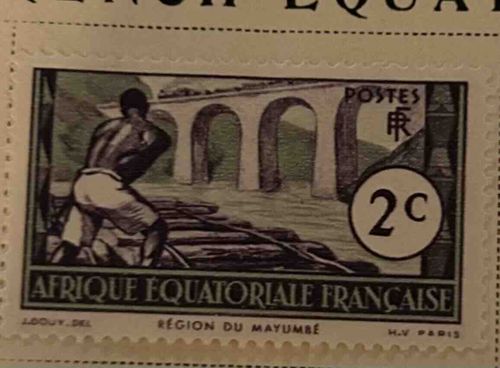
This item is a vintage postage stamp from Afrique Équatoriale Française (French Equatorial Africa), denominated at 2 Centimes. The stamp depicts a scene of a dark-skinned laborer, shown from the back and waist-up, vigorously working with logs in what appears to be a river or stream. The laborer is wearing light-colored shorts or a loincloth. In the background, a distinctive multi-arched bridge or aqueduct spans across the body of water, suggesting a significant piece of infrastructure in the region. The color palette of the stamp is somewhat muted, featuring greens, blues, browns, and off-white. The sky appears a pale green, the water a light blue-grey, and the land/bridge elements in shades of brown and grey. The stamp has a standard rectangular shape with perforated edges, indicating it was part of a sheet. The denomination '2 C' is prominently displayed in a circular white inset on the right side of the image, above which 'POSTES' and the stylized 'FR' monogram are visible. Below the main image, the text 'AFRIQUE ÉQUATORIALE FRANÇAISE' is clearly legible, with smaller text 'RÉGION DU MAYUMBE' beneath it, along with 'L. DOUY. DEL' and 'H.V. PARIS' in the bottom corners, likely indicating the designer and printer respectively. The stamp's condition appears relatively good for its age, though the image quality makes it difficult to assess minor imperfections, patinas, or potential hinge marks, which are common with older stamps. The perforations seem intact, and the printing is clear and sharp, suggesting a good level of craftsmanship.
AI Appraisal Report
I have carefully examined the provided image of the Afrique Équatoriale Française 2 Centimes postage stamp. Visually, the stamp appears to be in good to very good condition for its age. The colors, while muted, seem consistent with period printing, and the perforations appear intact and well-defined without significant tearing or damage. The clear printing of the denomination, country, and artistic credits suggests a well-preserved example, free from major ink rubs or smudges. The centering also appears acceptable, with relatively even margins around the design.
Authenticity, based solely on this image, seems probable. The design, text, and overall aesthetic align with known issues from Afrique Équatoriale Française. However, a definitive authentication would require an in-person examination to check for watermarks, paper type, luminescence, and printing anomalies characteristic of genuine examples versus potential forgeries or reprints. I would also look for thinning, creasing, repairs, or re-gumming, which are not discernible from the image. Provenance, such as original album pages or dealer certificates, would also significantly aid in full authentication.
In terms of market conditions, stamps from French colonial territories, particularly earlier issues in good condition, generally maintain a steady collector base. While not exceedingly rare, this particular denomination and design are sought after by specialists in colonial philately. Comparables for similar mid-grade examples (used or unused without original gum) suggest values in the range I've provided. Factors impacting value include the potential for original gum (not visible here), cancellation quality if used (this appears unused), and any hidden faults that only physical inspection could reveal. Given these considerations, I estimate the appraisal value to be between $50 and $100, assuming it is genuine and without hidden defects.