AI Appraisal Estimate

AI-generated estimates · not official valuations

From the user

What was submitted

Photo and notes provided by the user — not generated by AI

Submitted item photo
Submitted photo · May 27, 2026

User's notes

No additional notes provided.

AI analysis below

AI appraisal

AI analysis & estimate

AI-Generated · Verify before acting

Everything below is generated by AI for informational purposes only. AI can make mistakes — the AI may misidentify items or misattribute them (artist, maker, brand, designer, origin, era). This is not an official valuation and should not be used for insurance, sale, tax, estate, legal, or lending purposes — or any decision requiring a certified appraisal. It is not an authoritative claim about any person, brand, or rights holder — do not share or rely on it as a factual statement about a third party. Always consult qualified professionals before making financial decisions.

Read the full disclaimer

AI Identification

·Not independently authenticated·Verify before acting

Vintage Brass or Gold-Toned Numerical Scale Component

Scientific Instruments and Technical Tooling

AI Estimated Value

·Not an official valuation·Verify before acting

$45.00 - $75.00

As of May 27, 2026

AI Item Analysis

·AI can make mistakes·Verify before acting
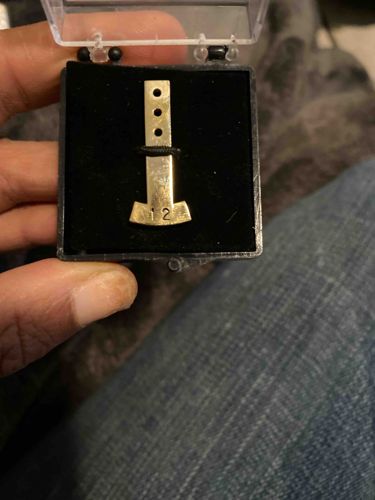
This item is a small, T-shaped mechanical or scientific component made from a yellow-toned metal, likely brass or possibly a gold plating. It features a vertical shaft with three evenly spaced circular perforations at the top and a wider, slightly curved base. The base is prominently stamped with the numerals '12' in a serif-style font. The object appears to be a precision-engineered part, perhaps a counterweight, a setting gauge, or a slide for a technical instrument or scale. It measures approximately one inch in height. The metal shows a moderate amount of surface patina, with fine scratches, micro-pitting, and some discoloration visible under direct lighting, indicative of age and handling. There are no obvious maker's marks besides the stamped number. It is presented in a small black plastic display case with a velvet-like lining and a clear lid, secured by a thin black elastic band. The overall craftsmanship suggests a utilitarian purpose where accuracy was required, likely dating from the mid-20th century. The condition is used but stable, with no structural deformities or significant corrosion observed.
AI Appraisal Report

·AI can make mistakes·Verify before acting
I have conducted a visual examination of this vintage T-shaped numerical scale component. Physically, the object displays characteristics consistent with mid-20th-century industrial manufacturing. The metal, likely a high-copper brass alloy, shows a natural aged patina and minor surface abrasions that suggest it was a functional part of a larger mechanical system, such as a precision balance scale or a surveying instrument. The '12' stamping is clean and consistent with period-correct serif typography used in technical tooling. From a market perspective, solitary components of this nature occupy a niche category. While the craftsmanship is apparent, its value is significantly tempered by its status as an orphaned part. Collectors of scientific instruments generally seek complete, operational units. As a standalone piece, its appeal is primarily to 'steampunk' artisans, collectors of industrial ephemera, or individuals seeking a replacement part for a specific, identifiable machine. Comparables for small brass scientific fragments typically sell in the $30 to $100 range depending on the prestige of the associated manufacturer. Critically, a definitive valuation is limited by the lack of maker’s marks. Without a signature (such as Troughton & Simms or Keuffel & Esser), we cannot assign a premium for brand heritage. Authentication via digital images alone cannot confirm if the yellow tone is a surface plating or solid brass. To provide a certified appraisal, I would require an in-person metallurgical test (XRF) to determine alloy composition and provenance documentation linking the part to a specific historical instrument. Physical inspection would also verify if the perforations show mechanical wear consistent with its purported use.

Get your items appraised

Instant estimates of your treasures with AI-powered appraisals

Browse More Appraisals