These notes were written by the person who submitted this item. Appraiser.AI has not verified them, and the AI's identification and estimate may rely on them.
AI Estimated Value
Not an official valuation
$25 - $75
AI estimate as of November 10, 2025 · verify with a professional before acting
AI-Generated · Verify before acting
Everything on this page is generated by AI for informational purposes only. AI can make mistakes — the AI may misidentify items or misattribute them (artist, maker, brand, designer, origin, era). This is not an official valuation and should not be used for insurance, sale, tax, estate, legal, or lending purposes — or any decision requiring a certified appraisal. It is not an authoritative claim about any person, brand, or rights holder — do not share or rely on it as a factual statement about a third party. Always consult qualified professionals before making financial decisions.
This analysis also relies on unverified notes provided by the user, which may be incomplete or inaccurate and could affect the result.
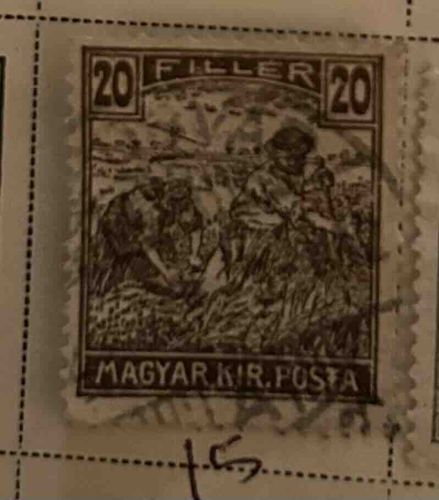
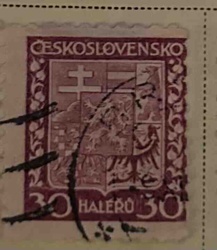
This item is a vintage Hungarian postage stamp, featuring a denomination of '20 FILLER'. The stamp's primary color appears to be a muted dark brown or sepia tone, suggesting an older printing process or a specific color choice for the era. Physically, it is rectangular with perforated edges, typical of postage stamps, and is currently housed in what appears to be a stamp album or collection sheet, indicated by the dotted grid lines around it. The central image depicts an agricultural scene with at least two individuals, likely farmers or harvesters, working in a field of tall crops, possibly wheat or rye. One figure is more prominently visible on the right, kneeling or bending, while another is partially obscured on the left. The artistic style is somewhat monochromatic and illustrative, focusing on the details of the figures and the field. The text 'MAGYAR KIR. POSTA' is visible at the bottom of the stamp, which translates to 'Royal Hungarian Post', indicating its country of origin and a period when Hungary was a kingdom. The denomination '20' is present in two upper corners, with 'FILLER' written horizontally between them. The overall condition shows some signs of age, including potential discoloration or minor creasing, and it is lightly postmarked or has some faint ink marks on the bottom margin outside the stamp itself, including a handwritten 'ts'. The perforations appear largely intact, though the exact crispness is hard to ascertain from the image resolution. The specific style and historical text suggest an estimated age from the late 19th or early 20th century, consistent with the era of the Austro-Hungarian Empire or the early independent Kingdom of Hungary before major political changes. The craftsmanship is typical of mass-produced stamps while maintaining a detailed artistic engraving.
AI Appraisal Report
I have examined the image of the Hungary 20 Filler stamp. This stamp, featuring an agricultural scene and marked 'MAGYAR KIR. POSTA', appears to be an authentic issue from the Kingdom of Hungary, likely dating from the late 19th to early 20th century. The design, text, and perforation style are consistent with known Hungarian postal issues of that period.
The stamp's condition, as observed from the image, is relatively good, though it shows clear signs of age, including a faint postmark or ink marks outside the lower margin, and potential minor discoloration on the stamp itself. The perforations appear intact. The value is significantly impacted by the handwritten 'ts' mark in the bottom margin, which is considered a fault and reduces desirability among collectors.
In terms of market conditions, this particular stamp is generally not considered rare. While it has historical interest, numerous examples exist, especially in used condition. Comparable stamps in fine used condition typically sell in the low to mid-range for classic European issues, with common varieties fetching modest prices. Stamps with significant faults, like the ink mark here, would fall on the lower end of that spectrum.
Demand for Hungarian stamps from this era is steady but not exceptional, unless it's a known rarity or in superb, fault-free condition. Therefore, based on the visible condition and general market activity for such items, and noting the detrimental handwritten mark, I estimate its appraisal value within the range of $25 to $75.
It is important to note that this assessment is based solely on the provided image. A full authentication and precise condition grading would require in-person examination to verify paper quality, watermarks, gum condition (if unused), and to detect any repairs, thinning, or hidden flaws not visible in a photograph. Provenance documentation, though helpful, is not critical for common issues like this one, but physical inspection remains paramount for definitive evaluation.