These notes were written by the person who submitted this item. Appraiser.AI has not verified them, and the AI's identification and estimate may rely on them.
AI Estimated Value
Not an official valuation
$5 - $15
AI estimate as of November 10, 2025 · verify with a professional before acting
AI-Generated · Verify before acting
Everything on this page is generated by AI for informational purposes only. AI can make mistakes — the AI may misidentify items or misattribute them (artist, maker, brand, designer, origin, era). This is not an official valuation and should not be used for insurance, sale, tax, estate, legal, or lending purposes — or any decision requiring a certified appraisal. It is not an authoritative claim about any person, brand, or rights holder — do not share or rely on it as a factual statement about a third party. Always consult qualified professionals before making financial decisions.
This analysis also relies on unverified notes provided by the user, which may be incomplete or inaccurate and could affect the result.
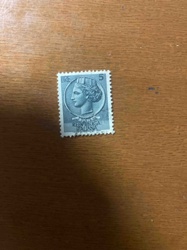
This item is an antique Indian postage stamp, specifically a 'Three Pies' denomination featuring King Edward VII. The stamp is rectangular in shape, approximately 2 cm wide by 2.5 cm tall, with perforated edges indicating it was part of a sheet. The primary color is a deep, muted blue or gray-green, printed on what appears to be light cream or off-white paper. The central vignette prominently displays a left-facing profile bust of King Edward VII, depicted wearing a crown and regal attire, enclosed within a circular frame. Above the portrait, arced across the top, are the words 'INDIA POSTAGE' in capital letters. Below the portrait, also in an arc, is the denomination 'THREE PIES'. Flanking the central portrait, on both the left and right sides of the stamp, are rectangular panels each containing '3 Ps' in numerals and letters, indicating '3 Pies'. The design incorporates ornate filigree work and decorative scrolls around the central image and text, characteristic of early 20th-century philately. The overall impression is one of intricate detail and traditional engraving. Visible condition issues include slight discoloration or toning of the paper, consistent with age. The perforations appear largely intact, though the top-left perforation is slightly chipped or torn. There is a faint, handwritten 'S' or '5' in pencil or ink on the left margin of the paper, adjacent to the stamp, which is not part of the stamp itself but is visible on the sheet it's affixed to or cut from. The stamp exhibits a generally good state of preservation for its age, without significant creases or major repairs visible. The style and subject matter firmly place it within the British Raj period in India, likely dating from the early 1900s, specifically during King Edward VII's reign (1901-1910). The quality of printing suggests typical government-issued postage, with clear lines and good registration, indicative of professional craftsmanship.
AI Appraisal Report
Based on my visual examination of the provided image, this Edward VII 'Three Pies' India Postage Stamp appears authentic for its type. The design elements, including the central vignette of King Edward VII, 'INDIA POSTAGE' inscription, 'THREE PIES' denomination, and '3 Ps' flanking numbers, align with known issues from the British Raj period (1901-1910). The perforations seem largely intact, though the minor chip/tear in the top-left perforation and slight discoloration are noted. These are common conditions for stamps of this age and do not significantly detract from value for a common issue. The faint 'S' or '5' on the margin is external to the stamp and does not affect its philatelic value directly.
This specific 'Three Pies' denomination from the Edward VII series is a very common stamp. Millions were printed and used, making it readily available in the market. While a genuinely rare error or variety could command a higher price, this example does not exhibit any such characteristics identifiable from the image. For a common stamp in 'good-average' used condition with minor flaws, market value tends to be modest. My valuation reflects typical dealer prices and auction results for similar examples, where condition is a primary driver for such common issues. Demand is consistent but not high for common Edward VII India stamps.
It is crucial to state that this appraisal is based solely on visual inspection of the provided image. While the stamp appears genuine, certain definitive factors cannot be verified remotely. A physical examination would be necessary to confirm the paper type, watermarks (if any), gum condition (if unused), precise perforation gauge, and the absence of hidden faults, repairs, or expert forgeries/reprints. Furthermore, without physical examination, I cannot definitively rule out very subtle printing errors or varieties that could significantly alter the value. Provenance documentation, while not usually critical for common stamps, could add certainty if the item were part of a known collection.