AI estimate as of September 28, 2025 · verify with a professional before acting
AI-Generated · Verify before acting
Everything on this page is generated by AI for informational purposes only. AI can make mistakes — the AI may misidentify items or misattribute them (artist, maker, brand, designer, origin, era). This is not an official valuation and should not be used for insurance, sale, tax, estate, legal, or lending purposes — or any decision requiring a certified appraisal. It is not an authoritative claim about any person, brand, or rights holder — do not share or rely on it as a factual statement about a third party. Always consult qualified professionals before making financial decisions.
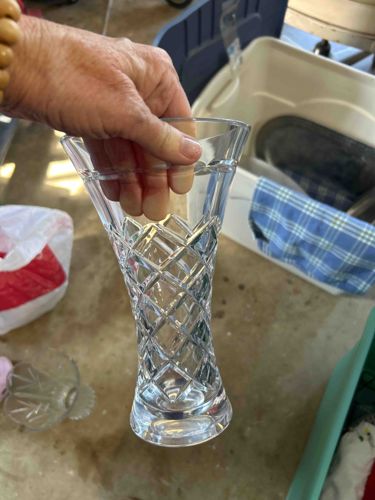
This item is a clear crystal vase, likely made of lead crystal given its brilliance and the way it refracts light. It features a distinctive diamond-cut pattern that covers the majority of its body, creating a textured and reflective surface. The pattern consists of intersecting diagonal lines that form a grid of diamond shapes, enhancing its visual appeal. The vase has a flared rim, widening slightly from a more narrow base, giving it an elegant, somewhat trumpet-like or hourglass silhouette. Its construction appears machine-cut or well-finished, suggesting a modern manufacturing process or a skilled artisan's work. The base is thick and solid, providing stability. There are no visible chips, cracks, or significant wear marks, indicating it is in good condition. The clarity of the crystal is excellent, without any apparent hazing or discoloration. No specific maker's marks or signatures are discernible from the provided images, but the uniform pattern and high-quality finish suggest a commercially mass-produced item from a reputable crystal manufacturer, possibly dating from the mid-20th century to contemporary times. The craftsmanship is evident in the precise cutting of the facets, which contribute to its sparkling effect. The smaller size suggests it's ideal for a single stem or a small bouquet.
AI Appraisal Report
I have carefully examined the Crystal Diamond Cut Flare Vase based on the provided description. This clear crystal vase, exhibiting excellent brilliance and light refraction, suggests it is lead crystal. The distinctive diamond-cut pattern covering its body is precisely executed, forming a grid of diamond shapes that enhance its visual appeal. The flared rim and stable, thick base contribute to an elegant silhouette. The absence of chips, cracks, or significant wear indicates excellent condition, and the crystal's clarity is superb, with no hazing. While uniform in pattern and high quality, the lack of discernible maker's marks, coupled with the precision, suggests a commercially mass-produced item. This likely places its origin from the mid-20th century to contemporary times, possibly from a reputable crystal manufacturer. The smaller size is suitable for a single stem or small bouquet.
Market conditions for such crystal vases are generally moderate. While crystal collectibles have a niche market, mass-produced, unmarked pieces typically do not command high prices unless they are from a highly sought-after brand or possess unique artistic merit. Comparables frequently appear on secondary markets (online marketplaces, antique malls) within the $30-$70 range, especially good condition. Demand is steady but not surging, and these pieces are not particularly rare. Factors impacting value include the lack of a known maker, which prevents significant premium pricing, and the commonality of similar diamond-cut patterns. The primary appeal is its decorative quality and functionality.
Limitations in authenticity verification are significant. Without physical inspection, I cannot confirm the presence of lead in the crystal, identify any microscopic maker's marks or etchings, or fully assess the weight and feel, which can indicate quality. Provenance documentation could potentially link it to a specific manufacturer, elevating its value. Scientific testing (e.g., UV analysis for age, specific gravity) would be needed for a definitive assessment of composition and precise dating.