AI estimate as of November 2, 2025 · verify with a professional before acting
AI-Generated · Verify before acting
Everything on this page is generated by AI for informational purposes only. AI can make mistakes — the AI may misidentify items or misattribute them (artist, maker, brand, designer, origin, era). This is not an official valuation and should not be used for insurance, sale, tax, estate, legal, or lending purposes — or any decision requiring a certified appraisal. It is not an authoritative claim about any person, brand, or rights holder — do not share or rely on it as a factual statement about a third party. Always consult qualified professionals before making financial decisions.
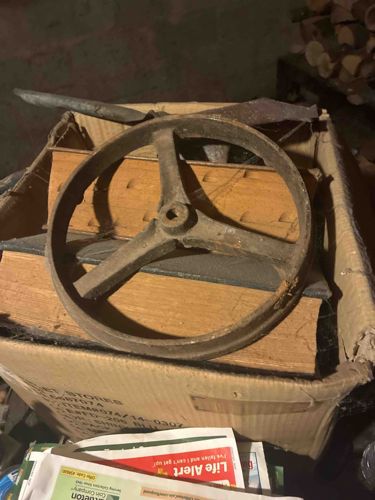
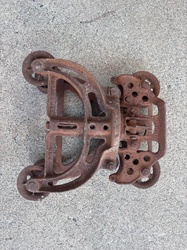
The item depicted is a vintage cast-iron wheel, likely functioning as a pulley or a hand wheel for a piece of antique machinery. It is constructed entirely of cast iron, exhibiting a dark, rusted, and heavily patinated surface, indicating significant age and exposure to the elements or storage in non-climate-controlled conditions. The wheel features a solid rim and three spokes radiating from a central hub. The hub has a circular opening in the center, designed to accommodate an axle or shaft, and appears to be squared off on the inside, suggesting it was once fitted onto a corresponding square shaft for rotation. The spokes are relatively thick and robust, tapering slightly as they extend from the hub to the rim. The overall construction points to an era of durable, heavy-duty manufacturing, possibly from the late 19th to mid-20th century, consistent with agricultural equipment, industrial machinery, or early mechanical devices. There are no discernible manufacturer's marks, signatures, or stamps visible in the image. The condition shows extensive surface rust and some dirt accumulation, but there are no obvious breaks, cracks, or repairs, suggesting structural integrity despite its aged appearance. The simple yet sturdy design is characteristic of functional mechanical components from its period. The item is currently sitting atop what appears to be a stack of wooden planks or blocks within a cardboard box, surrounded by other miscellaneous items.
AI Appraisal Report
Upon visual examination of the provided image, I assess this vintage cast-iron wheel, likely a pulley or handwheel, to be authentic to its described period, primarily due to its construction, patination, and design consistent with late 19th to mid-20th century industrial/agricultural components. Its condition, characterized by extensive surface rust and dirt, is typical for an item of this age left exposed to the elements or stored in non-climate-controlled environments. Crucially, I see no obvious breaks, cracks, or repairs, indicating structural integrity despite cosmetic aging. The squared-off central opening suggests its historical use on a corresponding square shaft.
Market conditions for such salvage items are generally stable, driven by decorators, restorers, and DIY enthusiasts seeking authentic industrial aesthetics. Comparable items, often found at antique markets, architectural salvage yards, or online marketplaces, typically fetch modest prices. The demand for a single, unmarked, general-purpose cast iron wheel of this nature is moderate, with rarity being low to medium unless it belonged to a highly desirable or identifiable piece of machinery.
Factors significantly impacting value include its robust construction and potential for decorative reuse (e.g., as a table base part or garden art). However, the lack of manufacturer's marks severely limits its collectibility and historical specificity, thereby capping its top-end value. Without such marks, it's difficult to tie it to a specific company or use, which would significantly increase its value.
It is important to note the limitations of authenticity verification from images alone. A physical inspection would allow for measurement, weight assessment, and microscopic examination for definitive material analysis and to confirm the absence of hidden repairs or casting flaws. Provenance documentation, though unlikely for such a utilitarian item, would provide irrefutable authentication of its history and origin. Scientific testing, such as material composition analysis, could pinpoint its manufacturing era more precisely. Based on visual examination, I estimate an appraisal value of $40-$70.