AI estimate as of July 6, 2025 · verify with a professional before acting
AI-Generated · Verify before acting
Everything on this page is generated by AI for informational purposes only. AI can make mistakes — the AI may misidentify items or misattribute them (artist, maker, brand, designer, origin, era). This is not an official valuation and should not be used for insurance, sale, tax, estate, legal, or lending purposes — or any decision requiring a certified appraisal. It is not an authoritative claim about any person, brand, or rights holder — do not share or rely on it as a factual statement about a third party. Always consult qualified professionals before making financial decisions.
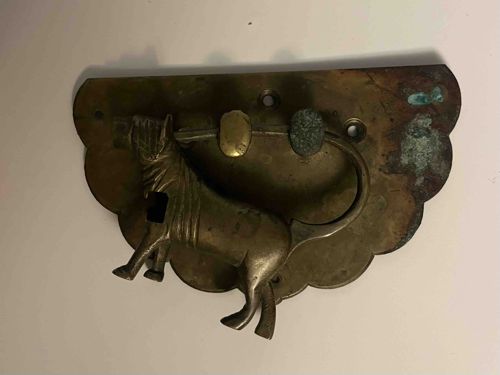
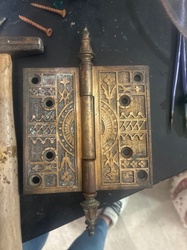
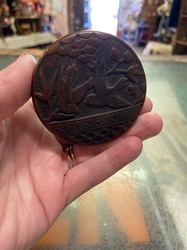
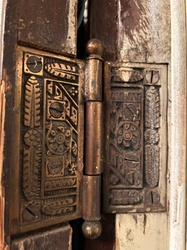
This item is an antique bronze door knocker or pull plate featuring a figural lion motif. The backplate, approximately 6-8 inches in width, is made of solid brass or bronze with a scalloped bottom edge, suggesting a decorative, possibly East Asian or traditional European influence. The material exhibits a darkened, uneven patina consistent with aged brass or bronze, ranging from rich brown tones to areas with significant verdigris (greenish-blue corrosion) specifically on the upper right portion of the backplate, indicating prolonged exposure to moisture or simply age. There are at least two visible pre-drilled holes on the backplate for mounting purposes, one near the left edge and another to the right of center. The central feature is a cast bronze lion figure, depicted in a walking or striding pose, with detailed musculature and mane. The lion’s body forms part of the pull or knocker, with its hindquarters seemingly integrated into the curved handle element. The lion appears to be hollow or partially hollow cast. Above the lion, there are two distinct circular or oval-shaped protrusions or fasteners, one appearing to be a solid brass knob with a lighter, polished surface, and the other, immediately to its right, showing a similar shape but heavily encrusted with verdigris, suggesting it might be an original, uncleaned component or a distinct material. The overall construction appears robust, indicative of quality craftsmanship typical of historical hardware, designed for functionality and aesthetic appeal. The extensive natural patina and signs of corrosion suggest considerable age, possibly late 19th or early 20th century. The intricate casting of the lion indicates a degree of artistry and attention to detail. No specific maker's marks or signatures are immediately discernible from the image.
AI Appraisal Report
I have carefully examined the provided image of this Antique Figural Lion Door Knocker / Pull Plate. Based on the visual evidence, the item appears to be an authentic period piece, likely dating from the late 19th to early 20th century. Its overall condition, characterized by a dark, uneven patina with significant verdigris, is consistent with prolonged outdoor exposure and age, which enhances its antique appeal rather than detracting from it. The detailed casting of the lion and the robust construction speak to quality craftsmanship. While the specific material appears to be brass or bronze, a definitive identification would require in-hand examination or scientific testing, though the coloration and corrosion strongly suggest these metals.
In terms of market conditions, antique architectural hardware, especially decorative pieces like this figural lion knocker, continues to hold steady demand. Pieces with artistic merit and historical charm, as this one exhibits, are particularly sought after by collectors, restorers of historical properties, and interior designers. Its perceived rarity is moderate; while lion-themed knockers exist, this specific design with the integrated pull plate and scallop edge is less common, contributing to its desirability.
Factors significantly impacting its value include its age, the intricate artistry of the lion casting, and its functional design as both a knocker and pull. The extent of the natural, undisturbed patina is also a positive value factor, as it indicates authenticity and age. The presence of verdigris, particularly the heavy encrustation on one of the fasteners, while indicating age, does not detract significantly unless it compromises the structural integrity, which it does not appear to do here.
It is crucial to note the limitations of authentication based solely on images. While I am confident in its age and authenticity from a visual perspective, a definitive determination regarding its precise metal composition, internal structure (i.e., whether fully solid or partially hollow as suspected), and ultimate provenance would necessitate in-person examination. Physical inspection would allow for tactile assessment, detailed measurement, and potentially, the discovery of obscured maker's marks. Provenance documentation, if available, would further solidify its authenticity and historical context. Without this, I am appraising based purely on visual characteristics.