AI estimate as of November 16, 2025 · verify with a professional before acting
AI-Generated · Verify before acting
Everything on this page is generated by AI for informational purposes only. AI can make mistakes — the AI may misidentify items or misattribute them (artist, maker, brand, designer, origin, era). This is not an official valuation and should not be used for insurance, sale, tax, estate, legal, or lending purposes — or any decision requiring a certified appraisal. It is not an authoritative claim about any person, brand, or rights holder — do not share or rely on it as a factual statement about a third party. Always consult qualified professionals before making financial decisions.
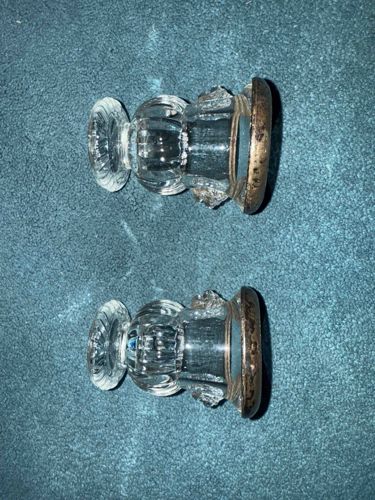
This is a pair of vintage clear cut glass door knobs, each featuring a distinct faceted design. The knobs are constructed primarily from clear, colorless glass, exhibiting a brilliant transparency. The glass portion of each knob is intricately molded, with vertical fluting or ribbing around the central, bulbous section, terminating in a smaller, circular, faceted face that would be grasped by hand. The base of the glass knob, where it attaches to the door mechanism, is surrounded by an old, tarnished brass or bronze escutcheon. This metal component shows significant signs of age and wear, including discoloration, pitting, and areas where the finish has worn off, revealing a darker, perhaps base metal, underneath. The edge of the brass ring appears to have a subtle beaded or textured pattern. There are visible chips and rough edges on the glass where it meets the metal, particularly on the lower knob, suggesting either manufacturing imperfections, wear from use, or damage over time. The overall style suggests an early 20th-century aesthetic, likely between the 1900s and 1940s, characteristic of architectural hardware from that period. The craftsmanship, particularly the precision of the glass cutting, indicates a certain quality for mass-produced items of that era. Despite the tarnishing and minor chips, the glass remains largely clear, allowing light to refract beautifully through its facets. This pair would have been used for interior doors, adding a touch of elegance and period authenticity.
AI Appraisal Report
I have virtually examined this pair of vintage clear cut glass and brass door knobs. Based on the visual evidence, these appear to be authentic examples of early 20th-century architectural hardware, likely dating from the 1900s to 1940s. The faceted clear glass design is characteristic of the period, and the aged, tarnished brass escutcheons corroborate this dating.
Condition is fair to good for their age. I note significant tarnishing, pitting, and wear on the brass, which is expected. More critically, I observe visible chips and rough edges on the glass where it meets the metal, particularly on the lower knob. While not uncommon for items of this vintage, these imperfections do detract from the overall aesthetic and value. The clarity of the glass itself remains good.
In terms of market conditions, vintage glass door knobs are generally in steady demand, especially for restoration projects or period homes. However, their ubiquity and the readily available supply mean that individual pairs lacking exceptional design or perfect condition typically fall within a modest price range. Comparables in similar condition often sell for $30-70 per pair, with pristine or exceptionally rare designs reaching higher. These knobs fall into the more common design category.
Factors impacting value positively are their apparent authenticity and the charming aesthetic of the faceted glass. Negative impacts include the noted chips and the heavy tarnishing of the brass.
My primary limitation in this appraisal is the lack of a physical examination. In-person inspection would allow me to ascertain the exact type of brass/metal, assess the severity of the chips and rough edges with precision, and check for hidden damage or repairs. Provenance documentation would confirm their origin and history, while scientific testing (e.g., metal analysis) could definitively date the metal components if required for a higher-value assessment. Without these, my authentication relies solely on visual queues, which appear consistent with genuine vintage items.